Agentic Drug Discovery in 2026: From Tool-Orchestrating Copilots to Lab-in-the-Loop Therapeutic Discovery
Building a Drug-Discovery Agent—What Actually Chains, and Where the Wall Is
tl;dr
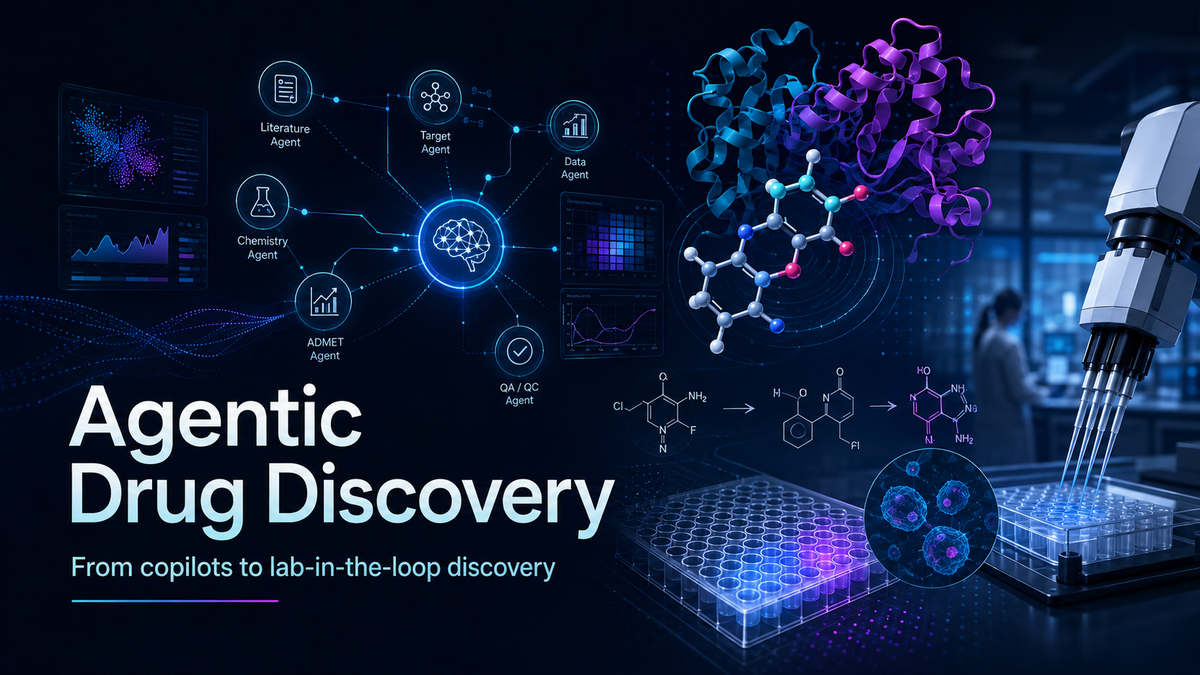
The LatentCell article, “Building a Drug-Discovery Agent—What Actually Chains, and Where the Wall Is,” offers a technically grounded corrective to exaggerated claims about autonomous pharmaceutical research. Its central argument is largely correct: in most current systems, the large language model is an orchestrator, not the principal scientific predictor. The LLM decomposes goals, retrieves evidence, invokes specialist models, tracks state and produces reports; chemistry, structural biology, pharmacology and synthesis tools perform most of the scientific computation.
Source: https://latentcell.ai/posts/agentic-drug-discovery/
However, the article’s claim that agentic drug discovery remains almost entirely on the computational side of a hard wet-lab boundary is now too categorical. By July 2026, several systems had begun to cross that boundary:
- Robin completed an iterative, laboratory-in-the-loop therapeutic-repurposing workflow for dry age-related macular degeneration, identifying and experimentally validating ripasudil and KL001 in cellular assays.
- The Virtual Lab designed 92 SARS-CoV-2 nanobodies, with experimentally validated binders, including two with improved binding to newer variants.
- MDForge generated a molecular-dynamics pipeline that prospectively identified a picomolar host–guest binder subsequently confirmed by competition NMR.
- CRISPR-GPT guided junior researchers through successful gene-editing experiments from design through data analysis.
These examples do not constitute an autonomous pharmaceutical company. Humans still select high-level goals, review candidates, execute or supervise experiments, manage safety and decide whether a result is biologically meaningful. Nevertheless, the field has progressed from purely computational orchestration to partially closed, human-supervised experimental loops.
The most accurate conclusion is therefore:
Agentic drug discovery has demonstrated useful orchestration, limited scientific hypothesis generation and several experimentally validated outputs, but it has not yet demonstrated a reproducible, end-to-end, autonomous target-to-development-candidate workflow for a new small-molecule medicine.
1. What “agentic drug discovery” actually means
An AI system becomes agentic when it does more than generate a single prediction. It must be able to:
- interpret a scientific objective;
- decompose it into dependent tasks;
- select and call external tools;
- preserve state across those tasks;
- evaluate intermediate outputs;
- revise its plan when a tool fails or evidence changes; and
- maintain a traceable record of decisions.
A representative architecture is:
Scientific objective → planner → evidence retrieval → specialist tools → evaluator → memory/provenance → revised plan → experimental recommendation
In a more mature system, this becomes:
Design → make → test → analyse → learn → redesign
The crucial distinction is between the agent and the scientific models it controls. AlphaFold 3 predicts biomolecular complex structures; DiffDock predicts ligand poses; Boltz-2 estimates structures and affinities; RDKit performs deterministic cheminformatics operations; docking and molecular-dynamics packages estimate interactions; retrosynthesis systems propose synthetic routes. The LLM decides which of these tools to use, constructs inputs and interprets their outputs. It generally does not independently calculate reliable binding affinity, toxicity or biological causality.
This division of labour explains why the most successful agentic systems are increasingly built around constrained workflows, validated tool registries, state machines and directed acyclic graphs, rather than unconstrained conversational reasoning.
2. Assessment of the LatentCell article
What the article gets right
2.1 Drug discovery is not a linear relay
The article correctly warns that target identification, structure prediction, hit generation, screening, lead optimization, ADMET assessment and retrosynthesis should not be interpreted as a one-way pipeline. Real discovery repeatedly moves backward when an assay fails, a compound is insoluble, a target proves non-causal, a metabolite is toxic or a synthetic route is impractical.
An agent therefore needs more than a sequence of API calls. It needs persistent molecular and biological state, explicit decision criteria and the ability to revise earlier assumptions.
2.2 The LLM is primarily the coordination layer
PharmAgents, LIDDIA, FROGENT, DrugPilot and the auditable molecular-optimization platform all depend on specialist tools. Their LLM components organize tasks, communicate between modules and produce explanations, while machine-learning models, databases and chemistry software perform generation, docking, property prediction or synthesis planning.
This is not a weakness. Drug discovery is inherently multidisciplinary, and orchestration across fragmented systems is itself valuable. But it is different from claiming that an LLM has acquired medicinal-chemistry or pharmacology expertise sufficient to replace validated computational and experimental methods.
2.3 Reported metrics are not comparable
The article appropriately rejects direct comparisons between:
- tool-calling completion rates;
- question-answering accuracy;
- molecular validity;
- docking scores;
- property-filter pass rates;
- synthetic-accessibility scores;
- biochemical potency; and
- cellular or in-vivo efficacy.
For example, TxAgent’s 92.1% accuracy is a result on therapeutic-reasoning benchmarks, not a molecule-discovery hit rate. DrugPilot’s 64% result measures completion of multi-turn function-calling tasks. The auditable optimization platform’s 31% improvement concerns predicted docking affinity and was accompanied by trade-offs in other molecular properties.
These metrics sit at different levels of the evidence hierarchy and should never be presented as interchangeable evidence of “drug-discovery success.”
2.4 State and provenance are genuine engineering bottlenecks
DrugPilot’s parameterized memory pool addresses information loss during long, heterogeneous workflows. The auditable optimization platform stores molecular lineage and tool-use summaries. Mozi goes further by using a control plane, workflow plane, role-based tool access, state-aware skill graphs and human checkpoints.
These designs reflect an important principle: a scientifically useful agent must retain not only its conclusions but also:
- the exact molecule version;
- source database and retrieval date;
- protein sequence and structure version;
- model and tool version;
- parameter settings;
- random seed;
- failed attempts;
- assay assumptions;
- uncertainty estimates; and
- the human interventions that changed the workflow.
Without this information, a fluent explanation is not a reproducible scientific record.
3. Where the article needs updating
3.1 The experimental-validation wall is cracking
The most important omission is Robin, published in Nature on May 19, 2026—more than two months before the LatentCell article.
Robin combined literature-search agents with an experimental-data-analysis agent. It proposed mechanisms and assays for dry age-related macular degeneration, ranked therapeutic candidates, analysed flow-cytometry and RNA-sequencing data, generated follow-up hypotheses and identified ripasudil and KL001 as enhancers of retinal pigment epithelium phagocytosis. Ripasudil was subsequently validated in primary human RPE-derived cells, and the system connected ROCK inhibition with increased ABCA1 expression.
This was a genuine iterative experimental loop, but not a fully autonomous one:
- humans reviewed the candidate ranking;
- the experimental protocol was human-generated;
- humans physically performed the experiments;
- researchers substituted some proposed assay components based on practical availability;
- human analyses were used to confirm agent-generated analyses; and
- in-vivo efficacy remains unproven.
Robin therefore weakens the claim that the wall is wholly unbroken, while simultaneously reinforcing the article’s deeper point: human scientific governance remains essential.
3.2 MDForge supplies a prospective wet-lab validation, but not yet a drug
MDForge, submitted in June 2026, treated molecular-dynamics pipeline design as open-ended code generation rather than selection from a fixed toolbox. A multi-agent debate mechanism generated structured critiques of pipeline components. The resulting workflow performed competitively on SAMPL host–guest benchmarks and identified a previously unseen CB[7] guest that was confirmed by competition NMR as a high-affinity picomolar binder.
This is prospective experimental validation of an agent-designed computational pipeline. Nevertheless:
- it is currently a preprint;
- the system addresses host–guest chemistry rather than a disease-associated protein target;
- a high-affinity host–guest binder is not a therapeutic lead;
- no cellular pharmacology, selectivity, ADME or safety evidence was reported.
MDForge should therefore be interpreted as an important validation of agentic scientific-method design, not as evidence that autonomous agents can already deliver medicines.
3.3 Biologics show faster closure of the loop than small molecules
The Virtual Lab used an LLM principal-investigator agent and specialized scientist agents to create a nanobody-design pipeline involving ESM, AlphaFold-Multimer and Rosetta. It proposed 92 nanobodies, which were produced and experimentally tested. Two showed improved binding to the JN.1 or KP.3 SARS-CoV-2 variants while retaining binding to the ancestral spike protein.
This is more scientifically consequential than an improvement in docking score because the output was physically produced and its function measured. However, it still represents AI–human collaboration: humans supplied high-level steering and carried out laboratory validation.
Biologics may be especially compatible with agentic discovery because protein language models, structure predictors, sequence-design tools and automated expression assays can be connected more naturally than the full small-molecule chain of generation, synthesis, purification, formulation, ADME and toxicology.
3.4 The article understates agentic experiment design outside conventional medicinal chemistry
CRISPR-GPT is not strictly a molecule-discovery platform, but it is relevant because it demonstrates what a domain-constrained experimental agent can accomplish. It uses task decomposition, state machines, retrieval, external design tools and user checkpoints. Junior researchers unfamiliar with gene editing successfully performed multigene knockouts and CRISPR activation experiments using its guidance.
The result supports a broader lesson: near-term agents may create more value by standardizing and executing complex experimental workflows than by inventing entirely novel therapeutics.
4. Current system landscape
PharmAgents
PharmAgents simulates a virtual pharmaceutical organization with modules spanning target discovery, lead identification, optimization and in-silico preclinical assessment. Its primary contribution is breadth and structured agent communication. Its outputs remain computational predictions without prospective synthesis or assay validation.
LIDDIA
LIDDIA uses a reasoner, executor, evaluator and memory architecture for molecular generation and screening. It generated molecules meeting its selected criteria for more than 70% of 30 clinically relevant targets and conducted a case study involving EGFR. It is one of the stronger peer-reviewed demonstrations of autonomous computational navigation, but the reported success is based on predicted and filtered molecular properties rather than measured activity.
FROGENT
FROGENT uses the Model Context Protocol to integrate databases, scientific software and AI models across target identification, molecular or peptide generation and retrosynthesis. It was evaluated across eight benchmarks and outperformed several ReAct-style baselines. Its principal innovation is interoperable tool orchestration rather than experimental discovery.
TxAgent and ToolUniverse
TxAgent accesses 211 biomedical tools and uses retrieval to select tools appropriate for drug-interaction, contraindication and treatment-reasoning tasks. It achieved 92.1% accuracy on its open-ended DrugPC benchmark. TxAgent is important as evidence for large-scale, grounded therapeutic reasoning, but it is closer to a pharmacological decision-support agent than a de-novo medicinal-chemistry platform.
DrugPilot
DrugPilot focuses on heterogeneous data handling and state preservation. It achieved completion rates of 98.0%, 93.5% and 64.0% on simple, multi-tool and multi-turn function-calling tasks, respectively. The fall to 64% on multi-turn tasks is revealing: even with a specialized memory mechanism, long-horizon reliability remains far below what would be required for unattended pharmaceutical research.
Auditable molecular optimization
The six-agent optimization platform improved predicted AKT1 docking affinity by an average of 31% in its multi-agent configuration. However, the single-agent system produced a more balanced drug-like profile, and unconstrained LLM runs completed faster while providing weaker provenance.
This demonstrates a recurring failure mode: an agent can optimize the metric it is shown while degrading properties outside that objective.
ToolMol
ToolMol combines an evolutionary algorithm with an LLM that modifies molecules through deterministic RDKit-backed tools rather than directly emitting SMILES strings. The authors report stronger predicted binding and absolute-binding-free-energy results across three targets, while substantially reducing invalid molecular outputs.
ToolMol’s design is important because it treats the LLM as a chemical strategy generator, while delegating exact graph manipulation to validated software. This is likely more robust than expecting language models to manipulate molecular strings reliably.
Mozi
Mozi introduces “governed autonomy”: a control layer restricts permissible actions, supervises agents, applies access controls and records decisions, while a workflow layer encodes scientific procedures as state-aware skill graphs. High-uncertainty boundaries trigger human review.
Although its scientific results remain computational, Mozi represents a plausible architecture for deployment in regulated R&D environments because scientific logic is enforced structurally rather than left entirely to probabilistic prompting.
5. The evidence hierarchy for agentic drug discovery
Claims about an agent should be classified according to the strongest evidence it has produced.
Level 1: Conversational or tool-use competence
Examples include answering drug questions, retrieving database records or correctly invoking software. TxAgent and DrugPilot demonstrate substantial progress here. This proves usability, not discovery.
Level 2: Molecular validity and heuristic property compliance
Generated molecules may pass valence checks, Lipinski-style filters, QED thresholds or synthetic-accessibility heuristics. These are useful quality controls but have weak relationships with therapeutic success when used alone.
Level 3: Predicted structures, docking and affinity surrogates
Docking scores, co-folding confidence and predicted affinity can prioritize candidates. They remain model-dependent surrogates. Even advanced models may perform inconsistently outside their training distribution or fail to rank closely related lead-series molecules at the resolution needed for medicinal chemistry. AlphaFold 3 substantially expands biomolecular complex prediction, while Boltz-2 aims to address affinity; independent assessments continue to find limitations in energetic ranking and generalization.
Level 4: Retrospective assay prediction
A system is tested against historical biochemical or cellular measurements withheld from the model. This is stronger than docking alone, but vulnerable to chemical-series overlap, temporal leakage and benchmark construction choices.
Level 5: Prospective synthesis and biochemical validation
Novel candidates are selected before assay results are known, synthesized and tested against a purified target. The Virtual Lab and MDForge provide versions of this evidence for nanobody binding and host–guest affinity, respectively.
Level 6: Cellular mechanism and selectivity
Candidates demonstrate activity in disease-relevant cells, with mechanism-of-action, cytotoxicity and selectivity controls. Robin reaches part of this level through primary-cell validation and mechanistic RNA-seq, although definitive disease-modifying activity remains unestablished.
Level 7: In-vivo efficacy, exposure and safety
A candidate demonstrates an adequate pharmacokinetic–pharmacodynamic relationship, efficacy in appropriate models, tolerability and a credible therapeutic window.
Level 8: Development-candidate and regulatory evidence
This requires scalable synthesis, formulation, ADME, toxicology, biomarkers, dose rationale, manufacturing controls and a defensible regulatory package.
Most agentic drug-discovery papers remain at Levels 1–3. A small number are beginning to reach Levels 5–6. None of the systems reviewed here establishes a complete autonomous progression through Levels 1–8.
6. Where agents are likely to create genuine value
6.1 Target and indication intelligence
Agents are well suited to connecting genetics, disease biology, pathways, omics, literature, clinical trials and pharmacology. This is a retrieval and evidence-integration problem in which provenance can be preserved.
Human genetic evidence is especially important. A large retrospective analysis estimated that drug mechanisms with human genetic support have a 2.6-fold greater probability of clinical success than those without such support, although the effect varies across therapeutic areas and development stages.
A credible target agent should therefore produce a structured therapeutic hypothesis containing:
- causal gene or pathway evidence;
- direction of modulation;
- human loss-of-function or gain-of-function evidence;
- tissue and cell-type context;
- genetic safety signals;
- tractability;
- competitive landscape;
- relevant biomarkers;
- contradictory findings; and
- confidence intervals or evidence grades.
The output should be an inspectable evidence graph, not a single target score.
6.2 Compound triage and active learning
Agents can coordinate library selection, docking, property prediction and diversity analysis. Active-learning approaches such as MolPAL have already shown that a relatively small fraction of a large library can be evaluated computationally while recovering many highly ranked candidates. The agentic contribution is to manage the iterative selection process, detect convergence and decide when expensive calculations are justified.
6.3 Multi-objective lead optimization
Lead optimization is naturally iterative and therefore well suited to agents. But the objective must include more than affinity:
- biochemical potency;
- cellular potency;
- selectivity;
- solubility;
- permeability;
- metabolic stability;
- clearance;
- CYP and transporter effects;
- hERG and safety liabilities;
- chemical stability;
- synthetic feasibility;
- novelty and freedom to operate; and
- developability appropriate to the intended route.
The auditable AKT1 study shows why this matters: stronger optimization of docking affinity did not automatically yield a better overall molecule.
6.4 Experimental planning and analysis
Robin, CRISPR-GPT and Coscientist indicate that agents can reduce the cognitive burden involved in reading protocols, selecting instruments, generating analysis code and interpreting multidimensional data. Coscientist has demonstrated chemistry planning, hardware-documentation retrieval, instrument control and reaction optimization in an automated laboratory setting.
This may be the most immediately deployable opportunity: not replacing scientists, but making experimental cycles more standardized, searchable and reproducible.
6.5 Drug repurposing
Repurposing is a particularly tractable agentic use case because:
- compound identities are fixed;
- safety and pharmacology information already exists;
- literature and clinical evidence are abundant;
- synthesis is often unnecessary for initial testing; and
- biological hypotheses can be assessed relatively quickly.
Robin’s ripasudil result illustrates this advantage.
7. Remaining scientific and engineering bottlenecks
7.1 Weak or misaligned objective functions
Agents optimize what they can measure. If the reward is a docking score, the agent may produce highly charged, oversized or synthetically implausible molecules. If the reward is QED, it may converge on generic drug-like structures without target potency.
A mature system requires constrained multi-objective optimization, Pareto-front reporting and explicit rules preventing one objective from silently dominating the others.
7.2 Biological causality
A high-affinity ligand against the wrong target is not a useful medicine. Target–disease association scores can encode correlation, publication bias or confounding. Agents need causal genetics, perturbation data, longitudinal evidence and disease-relevant models—not merely literature frequency.
7.3 Out-of-distribution generalization
Chemical and biological datasets are highly clustered. Random splits may place nearly identical scaffolds, protein families or assay conditions in training and test sets. Performance can collapse when an agent encounters a genuinely novel scaffold, target class or experimental context.
7.4 Uncertainty calibration
Current systems frequently provide confident narratives around uncertain outputs. Each tool call should return calibrated uncertainty and applicability-domain information. The orchestrator must preserve that uncertainty rather than converting it into a falsely definitive prose conclusion.
7.5 Error propagation
A mistaken protein isoform can corrupt structure prediction, docking, molecular generation and retrosynthesis downstream. Long workflows need validation gates at every transition:
- sequence identity check;
- structure-quality check;
- binding-site confidence;
- ligand protonation and tautomer review;
- assay-context verification;
- duplicate and artefact detection; and
- synthetic-route feasibility review.
7.6 Stochastic and non-reproducible analysis
Robin explicitly observed that repeated data-analysis trajectories could choose different flow-cytometry gates or RNA-seq filters. It managed this by running multiple trajectories and deriving a consensus.
Consensus can reduce variance, but it does not guarantee correctness. Reproducible agents should separate:
- deterministic preprocessing;
- pre-specified statistical analysis;
- exploratory analysis;
- sensitivity analysis; and
- narrative interpretation.
7.7 Benchmark limitations
SMDD-Bench introduced 502 multi-turn tasks covering pharmacophore identification, interaction-point discovery, scaffold hopping, lead optimization and fragment assembly across 102 targets. The best model evaluated in the paper solved only 40.2% of tasks.
This result supports the view that long-horizon molecular reasoning is not solved. It also highlights the need for benchmarks that test:
- chemically meaningful decisions rather than tool syntax;
- prospective generalization;
- limited experimental budgets;
- recovery from failed hypotheses;
- multimodal evidence;
- multi-objective trade-offs; and
- reproducibility across repeated runs.
7.8 Governance and regulatory credibility
FDA’s 2025 draft guidance on AI outputs used for regulatory decision-making emphasizes defining the question of interest, context of use, model risk, credibility plan, execution and lifecycle maintenance. The guidance formally excludes discovery-only uses, but the same principles become relevant when agent-produced outputs affect nonclinical, clinical, manufacturing or regulatory decisions.
In January 2026, FDA and EMA also published ten guiding principles for good AI practice in drug development.
For agentic systems, this implies:
- locked and versioned models for critical decisions;
- validated tools;
- documented context of use;
- human accountability;
- access controls;
- model-change management;
- audit trails;
- data lineage; and
- risk-proportionate validation.
An agent that silently changes models, prompts or databases cannot support a defensible regulated workflow.
8. What a credible next-generation platform should contain
A scientifically credible architecture would include six layers.
Layer 1: Evidence and data fabric
A versioned integration of literature, patents, clinical trials, human genetics, omics, structures, assays, compounds and internal experimental data.
Layer 2: Validated scientific tool registry
Each tool should have:
- defined inputs and outputs;
- unit and schema validation;
- version information;
- applicability domain;
- test cases;
- known failure modes;
- latency and cost; and
- licensing restrictions.
Layer 3: Constrained workflow engine
Scientific procedures should be represented as explicit graphs rather than free-form conversations. A docking step should not begin until protein preparation, ligand standardization and binding-site selection have passed validation.
Layer 4: Agentic planning and exception handling
The LLM should choose among approved workflows, explain choices, manage failures and request expert review when uncertainty exceeds a threshold.
Layer 5: Experimental interface
The system should connect computational hypotheses to laboratory-information-management systems, electronic laboratory notebooks, robotic platforms and assay instruments.
Layer 6: Audit and governance plane
Every decision should be reconstructable from immutable provenance records. Human approvals should be captured as part of the scientific history rather than occurring outside the system.
Mozi’s dual-plane design, DrugPilot’s structured memory, ToolUniverse’s registry and Robin’s lab-in-the-loop analysis each provide elements of this architecture.
9. Strategic outlook
Near term: copilots and bounded agents
The highest-confidence applications are:
- literature and target-evidence synthesis;
- competitive-intelligence surveillance;
- protocol generation from validated templates;
- assay-data analysis;
- computational workflow orchestration;
- compound triage;
- retrosynthesis comparison;
- structured decision reports; and
- repurposing-hypothesis generation.
These activities reduce search and coordination costs while keeping scientists accountable for consequential decisions.
Medium term: human-supervised closed loops
The next stage will integrate agents with:
- automated synthesis;
- high-throughput screening;
- cellular phenotyping;
- transcriptomic or morphological readouts;
- active learning; and
- rapid design revision.
Autonomous chemistry systems and mobile robotic platforms already demonstrate parts of this loop. Mobile robots have integrated synthesis and analytical platforms across multiple chemistry problems, although humans still defined the scientific domain and goals.
Longer term: autonomous program management
A genuine autonomous discovery program would need to:
- identify a causal and tractable target;
- design a differentiated intervention;
- produce and assay candidates;
- diagnose failures;
- redesign compounds;
- demonstrate mechanism, selectivity and exposure;
- establish efficacy and safety;
- select a development candidate; and
- generate a reproducible evidence package.
No published system reviewed here has completed this entire chain. Progress at individual nodes should not be conflated with completion of the whole program.
Conclusion
The LatentCell article is valuable because it correctly shifts attention away from anthropomorphic claims about “AI scientists” and toward the less glamorous but essential infrastructure of tool integration, state and provenance.
Its central formulation—orchestration rather than independent scientific intelligence—remains a useful description of most systems. Yet the frontier has moved beyond purely in-silico demonstrations. Robin, the Virtual Lab, MDForge and CRISPR-GPT show that agents can now participate in experimentally validated loops when the domain is constrained, specialist tools are available and humans remain involved.
The decisive question is no longer whether an LLM can call a docking program or generate a plausible molecule. It is whether the entire system can produce a prospective, reproducible and decision-relevant improvement in experimental outcomes.
The field should therefore stop treating “autonomy” as a binary label. Agentic drug-discovery systems should instead be evaluated along separate axes:
- breadth of pipeline coverage;
- degree of human intervention;
- quality of scientific tools;
- provenance and reproducibility;
- uncertainty calibration;
- prospective validation;
- biological relevance;
- experimental closure; and
- regulatory credibility.
On that basis, the current generation is best described as scientific orchestration infrastructure with emerging lab-in-the-loop capabilities—not yet autonomous pharma, but already more than a conversational demonstration.
Selected original sources
- Gao et al. PharmAgents: Building a Virtual Pharma with Large Language Model Agents.
- Averly et al. LIDDIA: Language-based Intelligent Drug Discovery Agent.
- Pan et al. FROGENT: An End-to-End Full-process Drug Design Agent.
- Gao et al. TxAgent: An AI Agent for Therapeutic Reasoning Across a Universe of Tools.
- Li et al. DrugPilot: LLM-based Parameterized Reasoning Agent for Drug Discovery.
- Ünlü et al. An Auditable Agent Platform for Automated Molecular Optimisation.
- Zhou et al. ToolMol: Evolutionary Agentic Framework for Multi-objective Drug Discovery.
- Ghareeb et al. A multi-agent system for automating scientific discovery—Robin.
- Swanson et al. The Virtual Lab of AI agents designs new SARS-CoV-2 nanobodies.
- Wang et al. MDForge: Agentic Molecular Dynamics Pipeline Design under Sparse Simulator Feedback.
- Qu et al. CRISPR-GPT for agentic automation of gene-editing experiments.
- Boiko et al. Autonomous chemical research with large language models—Coscientist.
- Dai et al. Autonomous mobile robots for exploratory synthetic chemistry.
- Abramson et al. Accurate structure prediction of biomolecular interactions with AlphaFold 3.
- Minikel et al. Refining the impact of genetic evidence on clinical success.
- FDA. Considerations for the Use of Artificial Intelligence to Support Regulatory Decision-Making for Drug and Biological Products.
Comments ()