Claude Science and the Vertical-Integration Trap
Is Anthropic becoming pharma’s infrastructure provider—or its future competitor?
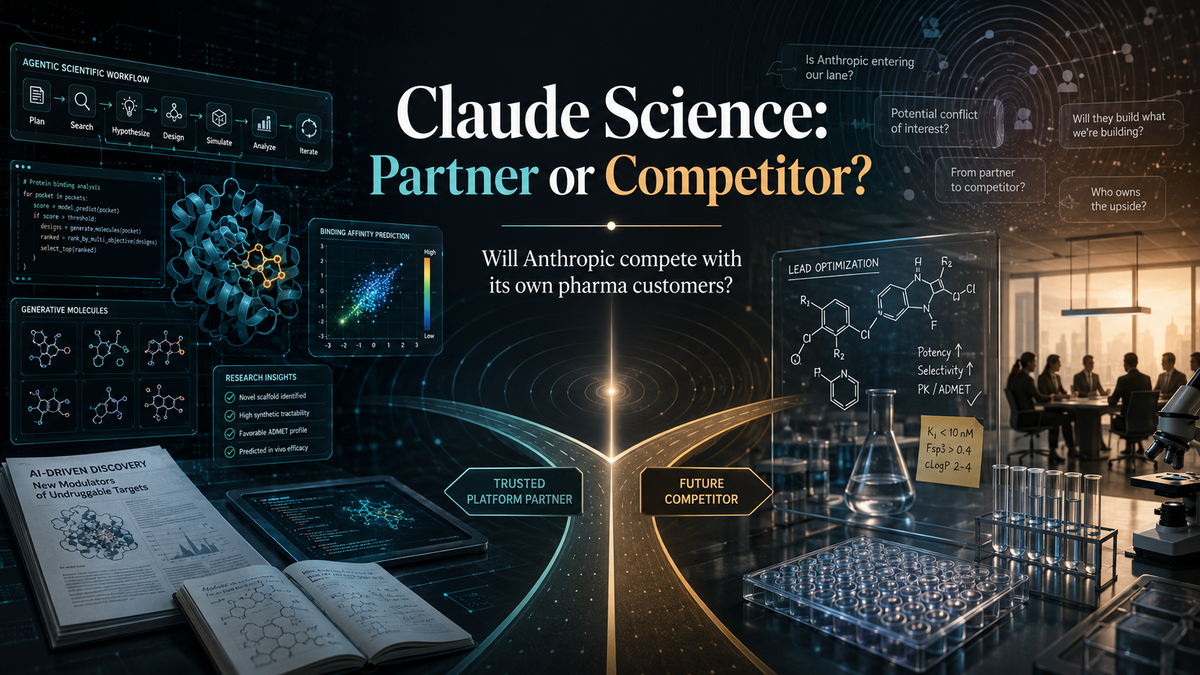
tl;dr: When Anthropic launched Claude Science on June 30, 2026, the product itself looked relatively uncontroversial. It was essentially an agentic scientific workbench: one environment connecting literature, scientific databases, code, visualization tools, protein structures, cheminformatics packages and high-performance computing.
Claude Science can coordinate specialist agents, query more than 60 scientific resources, run analyses on local or remote infrastructure and preserve the code, environment and conversational history behind its outputs. Anthropic describes it as a reproducible research environment rather than a new biological foundation model.
The controversy arose from what Anthropic announced alongside it.
The company said it would begin running its own preclinical drug programmes, initially focusing on neglected diseases that conventional pharmaceutical companies may consider commercially unattractive. Anthropic presented this as a form of industrial “dogfooding”: by attempting real drug discovery itself, it could identify weaknesses in Claude Science and improve the product for scientific customers.
That explanation is technically plausible. It is also strategically incomplete.
Once a platform company begins originating therapeutic assets, it crosses an important boundary. It is no longer merely helping customers conduct research. It is participating in the allocation of targets, molecules, intellectual property and scientific talent that determines who owns the next generation of medicines.
The central question is therefore not whether Claude Science can help discover drugs. It almost certainly can. The question is whether Anthropic can simultaneously act as a trusted infrastructure provider and an economically interested participant in drug discovery.
The backlash is about role conflict, not Claude Science
Much of the criticism has been framed too dramatically. Anthropic has not suddenly become Pfizer, Novartis or Roche. It has not announced a clinical-stage pipeline, manufacturing infrastructure, regulatory organisation or commercial sales force.
Drug discovery is also not reducible to running a sufficiently capable language model. Computational hypothesis generation and molecular design remain only parts of an experimentally intensive process involving assay development, medicinal chemistry, pharmacokinetics, toxicology, formulation, manufacturing and human clinical trials. Experts interviewed about Anthropic’s plans stressed that AI has not made these experimental steps unnecessary.
Nevertheless, the backlash identifies a genuine governance problem.
Anthropic is already deeply embedded in pharmaceutical workflows. Bristol Myers Squibb announced that Claude would be made available to more than 30,000 employees, with potential applications ranging from target identification and optimisation to clinical documentation, manufacturing and medical affairs. Anthropic has also highlighted work involving Novo Nordisk, Sanofi and other life-science organisations.
A company cannot credibly ask to become the “intelligence layer” across pharmaceutical R&D while treating its own entry into asset discovery as a minor product-testing exercise.
The concern is not that Anthropic will secretly copy a customer’s molecule from a prompt. Anthropic states that, by default, inputs and outputs from its commercial products are not used to train its models. Claude Science can also operate on a laboratory’s own infrastructure, with sensitive datasets remaining within that environment.
Those protections matter, but model-training policy is only one element of competitive neutrality.
A platform provider can acquire valuable strategic intelligence without training on the underlying data. It may learn which integrations customers repeatedly request, which scientific bottlenecks consume the most compute, which disease areas are receiving new investment, which modelling approaches fail most often and where customers are willing to pay for acceleration.
That does not imply misconduct. It means that access to ecosystem-level demand signals can create an information advantage even when individual customer data remains contractually protected.
Will Anthropic directly compete with pharmaceutical customers?
The most accurate answer is: not immediately at the commercial level, but increasingly at the discovery level.
Competition should be divided into three layers.
1. Workflow competition: already happening
Claude Science competes with scientific software platforms, computational notebooks, specialised AI-biology tools, data-integration companies and agentic drug-discovery startups.
This is its clearest immediate competitive impact. Anthropic is attempting to own the orchestration layer through which scientists access databases, models, code and compute.
That is strategically similar to Claude Code. Anthropic does not need to own every underlying tool if Claude becomes the primary interface through which those tools are selected and operated.
The first companies threatened may therefore be scientific-software vendors and AI-native discovery platforms—not traditional pharmaceutical manufacturers.
2. Asset-origination competition: beginning now
By initiating preclinical programmes, Anthropic will participate in target selection, hypothesis formation, molecule generation and candidate prioritisation.
At that point, two organisations using Claude Science could theoretically compete for the same target or biological mechanism, while Anthropic itself operates a third programme using the same underlying platform.
Anthropic says it will initially concentrate on neglected diseases. That reduces immediate overlap but does not eliminate it.
“Neglected” is not a permanent commercial category. Scientific discoveries can transform an unattractive target into a valuable platform opportunity. A mechanism investigated in a rare disease may also have applications in oncology, immunology, metabolic disease or neurodegeneration.
Rare-disease development is not necessarily economically irrelevant either. US orphan-drug designation can provide tax credits, fee waivers and potentially seven years of market exclusivity following approval.
A programme that begins as public-benefit research can therefore generate commercially valuable intellectual property.
3. Clinical and commercial competition: possible, but unproven
Anthropic has not publicly clarified whether it intends to nominate development candidates, file patents, submit investigational applications, sponsor clinical trials or commercialise products.
This missing information is the most important weakness in its announcement. The distinction between a scientific demonstration and a pharmaceutical pipeline depends on what happens after a promising molecule is identified.
Anthropic has several possible models:
- publish findings openly;
- create patent-free neglected-disease programmes;
- license candidates to non-profits or biotechnology companies;
- co-develop assets with pharmaceutical partners;
- establish a separate biotech subsidiary;
- retain ownership and become a conventional drug developer.
Only the last two would create sustained, direct competition with pharma customers. But Anthropic has preserved all of these strategic options.
That option value is precisely why customers are justified in asking questions now rather than waiting for the first clinical candidate.
Why pharma companies will probably continue using Claude
Despite the concerns, a wholesale pharmaceutical retreat from Anthropic is unlikely.
Large drug companies routinely collaborate with organisations that also possess independent pipelines. They manage this through target-specific agreements, intellectual-property provisions, programme firewalls and portfolio-level conflict assessments.
Alphabet’s Isomorphic Labs demonstrates that a company can build proprietary drug-discovery capabilities while partnering with major pharmaceutical companies. Isomorphic operates as a separate commercial drug-discovery venture and has signed collaborations with Eli Lilly and Novartis potentially worth billions of dollars.
Pharmaceutical companies also avoid technological dependence through multi-vendor strategies. A company may use Claude for scientific reasoning, another provider’s models for particular biological tasks, NVIDIA infrastructure for model execution and proprietary internal systems for sensitive programmes.
Claude’s value may outweigh its strategic risk, particularly if it materially reduces documentation time, improves scientific search or connects fragmented internal data.
The likely response will therefore not be abandonment. It will be stricter procurement.
Pharma companies will ask whether Anthropic’s internal discovery teams are legally and operationally separated from its enterprise business. They will demand clarity on telemetry, retention, technical support access, fine-tuning, intellectual-property ownership, employee mobility and conflicts involving overlapping targets.
What Anthropic must do
Anthropic can preserve trust, but verbal assurances about neglected diseases will not be sufficient.
First, it should establish a legally distinct drug-discovery entity with separate leadership, personnel, data systems and governance. Alphabet’s separation of Isomorphic Labs from its general AI and cloud businesses provides a more credible structure than running customer services and internal drug programmes inside the same organisational unit.
Second, Anthropic should publish a binding competitive-neutrality policy covering:
- prohibition on using customer inputs, outputs, derived embeddings or support materials for internal drug programmes;
- separation of enterprise technical-support teams from internal discovery scientists;
- auditable access logs for customer environments;
- customer-defined target and indication exclusion lists;
- transparent rules for handling independently convergent discoveries;
- advance disclosure when Anthropic enters an overlapping disease or target area;
- independent dispute-resolution and intellectual-property procedures.
Third, Anthropic should clarify the intended endpoint of its programmes. A public-benefit neglected-disease initiative is meaningfully different from a proprietary pipeline designed to generate licensable assets.
Fourth, customers should receive parity of access. Anthropic’s internal scientists should not have privileged access to materially more capable biological models, longer contexts, unrestricted scientific tools or unpublished benchmark information while commercial customers are asked to build their pipelines on a constrained version of the platform.
This issue is particularly sensitive because some researchers have already criticised Anthropic’s biological safety restrictions as overly broad. The combination of restrictive external access and privileged internal drug discovery would create a much stronger anticompetitive perception, regardless of Anthropic’s safety rationale.
Supplier, partner and competitor
Anthropic will probably occupy all three roles.
It will remain a supplier of foundation models and enterprise AI. It will become a development partner for selected pharmaceutical programmes. And, through its internal discovery work, it will compete for at least some targets, talent and intellectual property.
This type of “coopetition” is not unprecedented. What is unusual is the depth at which Claude could become embedded within customers’ scientific reasoning and operational infrastructure.
The backlash should therefore not be dismissed as resistance to technological progress. It is a rational response to vertical integration in an industry where confidentiality, target selection and information asymmetry have enormous economic consequences.
At the same time, claims that Anthropic has already declared war on the pharmaceutical industry are premature. Its current programmes appear preclinical, narrow and deliberately positioned outside conventional commercial priorities.
The decisive question is what Anthropic builds next.
If it ring-fences its drug programmes, offers contractual neutrality and directs neglected-disease discoveries into transparent partnerships, Claude Science could become a powerful enabling platform without materially threatening its customers.
If it quietly accumulates proprietary assets while becoming the default operating layer for pharmaceutical research, the present backlash will look less like paranoia and more like an early warning.
Anthropic has not yet become its pharma customers’ direct commercial competitor. But it has created the organisational capability—and retained the strategic option—to become one.
Comments ()