Reinforcement Learning from Human Feedback (RLHF)
The Definitive Guide for Developers and Entrepreneurs in 2026
Reinforcement Learning from Human Feedback (RLHF) is the technique that transformed raw large language models (LLMs) into helpful, aligned assistants like ChatGPT, Claude, and Grok. It bridges the gap between a model’s next-token prediction training and real human preferences — helpfulness, honesty, harmlessness, creativity, and tone.
For developers, RLHF is now accessible via open-source libraries.
For entrepreneurs, it is the competitive moat that turns generic AI into product-ready, user-delighting systems.
This in-depth article explains RLHF technically (with code-ready insights), its business value, implementation paths (including AWS), challenges, and 2026 alternatives like Direct Preference Optimization (DPO). Whether you’re fine-tuning a 7B model on a single GPU or scaling enterprise AI agents, you’ll leave with actionable knowledge.
Why RLHF Matters: Beyond Supervised Learning
Traditional LLMs excel at predicting the next token but often produce verbose, off-topic, or unsafe outputs. Human values are subjective and hard to encode in a fixed loss function like cross-entropy. RLHF solves this by treating alignment as a reinforcement learning problem: the model learns a policy (how to generate text) that maximizes a reward derived from human judgments.
Key benefits (straight from AWS and industry data):
- Accuracy and naturalness: Models produce fluent, context-aware responses instead of technically correct but robotic ones.
- Complex, subjective behaviors: Mood in music generation, brand voice in content, empathy in chatbots — things impossible to define with rules.
- User satisfaction and safety: Higher preference scores, reduced toxicity, better truthfulness.
In 2026, RLHF (or its successors) powers most production LLMs, AI agents, and multimodal systems.
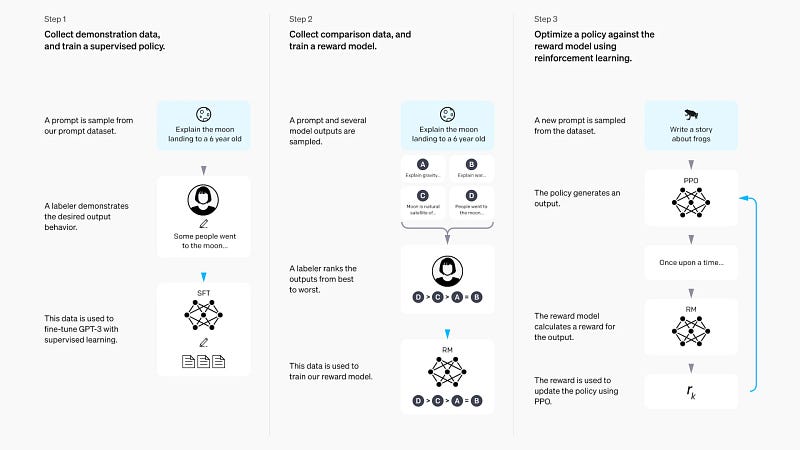
The RLHF Pipeline: Four Stages (Technical Deep Dive for Developers)
RLHF builds on a pretrained LLM through four stages, as outlined by AWS and refined in OpenAI’s InstructGPT (the blueprint for modern alignment).
- Data Collection (Demonstration Data) Gather prompts (user questions) and high-quality human-written responses. This becomes your supervised fine-tuning (SFT) dataset. Example: Internal company knowledge-base prompts + expert answers.
- Supervised Fine-Tuning (SFT) Fine-tune the base LLM on the demonstration data using standard causal language modeling. This creates a “helpful baseline” policy π_SFT. Use parameter-efficient methods like LoRA for speed and memory efficiency.
- Reward Model Training Generate multiple responses per prompt from the SFT model. Humans rank them (e.g., “A better than B”). Train a separate reward model r_θ (often the same size or smaller than the policy) to predict scalar rewards from these preferences.
Loss (pairwise Bradley-Terry model):

where yw is the winning response and yl is the losing one.
4. Policy Optimization with Reinforcement Learning: Use the reward model as the reward function. Optimize the policy with Proximal Policy Optimization (PPO) while adding a KL-divergence penalty to prevent drifting too far from the SFT model (avoids reward hacking). Reward:

The policy πθ now generates outputs that humans would prefer.
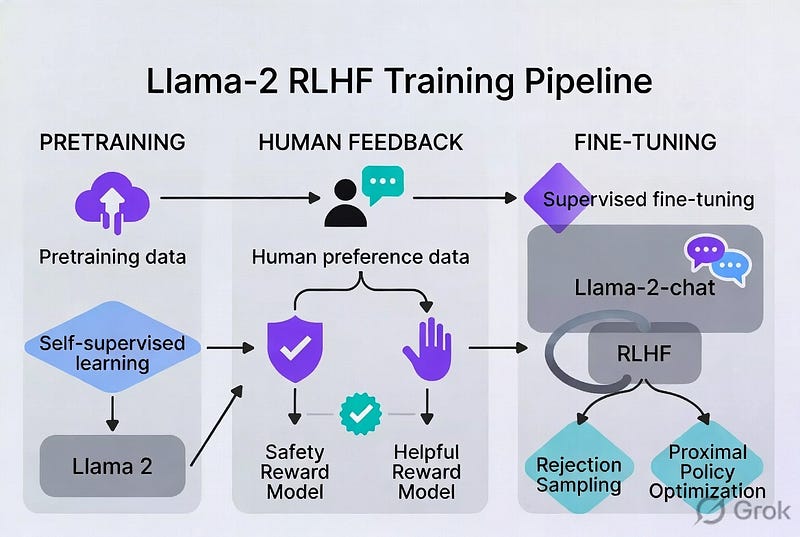
Visual Overview of the Pipeline
Practical Example: StackLLaMA (Hugging Face TRL) The open-source StackLLaMA project trains LLaMA-7B to answer Stack Exchange questions using exactly this pipeline on consumer-grade hardware. It uses 8-bit loading + LoRA, trains the reward model on upvote-based preference pairs, and runs PPO in ~20 hours on 3×8 A100 GPUs. Full code and datasets are on the Hub.
Implementation Guide for Developers
Tools You Need in 2026:
- Hugging Face TRL (Transformer Reinforcement Learning): Provides SFTTrainer, RewardTrainer, and PPOTrainer. Supports PEFT (LoRA/QLoRA), Accelerate for multi-GPU, and Weights & Biases logging.
- PEFT + BitsAndBytes: Train 70B+ models on modest hardware.
- AWS SageMaker Ground Truth: Enterprise-grade human labeling with built-in RLHF workflows, active learning, and integration into SageMaker training jobs. Perfect for custom domains.
- Alternatives: DeepSpeed, Axolotl, or Unsloth for faster LoRA training.
Quick Start Pseudocode (TRL-style):
# 1. SFT
model = AutoModelForCausalLM.from_pretrained("meta-llama/Llama-3-8B", load_in_8bit=True)
peft_config = LoraConfig(r=16, lora_alpha=32, ...)
trainer = SFTTrainer(model, train_dataset=dataset, peft_config=peft_config)
trainer.train()

# 2. Reward Model
reward_model = AutoModelForSequenceClassification.from_pretrained(...)  # or same base
reward_trainer = RewardTrainer(model=reward_model, train_dataset=preference_pairs)
reward_trainer.train()

# 3. PPO
ppo_trainer = PPOTrainer(model, ref_model=sft_model, reward_model=reward_model, ...)
for batch in dataloader:
    responses = ppo_trainer.generate(...)
    rewards = reward_model.score(prompts + responses)
    ppo_trainer.step(responses, rewards)  # includes KL penalty
Pro Tips:
- Start with a strong SFT model — alignment can’t fix a weak base.
- Monitor reward hacking (model gaming the reward model with repetitive phrases).
- Use rejection sampling or best-of-N during inference for quick wins without full RL.
Business Opportunities for Entrepreneurs
RLHF isn’t just technical — it’s a product differentiator:
- Customer Service & Agents: Empathetic, brand-aligned chatbots that reduce escalations (real ROI in 2026 enterprise deployments).
- Content & Creative Tools: Marketing copy, code generation, or image prompts that match exact tone/brand voice.
- Vertical AI Products: Healthcare decision support, legal drafting, personalized education — where “human-like” judgment wins trust.
- AI Agents & Self-Improving Systems: RLHF loops enable agents that learn from user corrections in production, creating data flywheels and defensible moats.
- Monetization: Offer RLHF-as-a-service (human feedback platforms), domain-specific aligned models, or “Service-as-Software” where human oversight feeds continuous improvement.
Cost vs Value: Labeling is expensive, but one strong preference dataset can differentiate your product for years. Startups using Scale AI or custom pipelines report 2–5× higher user retention.
Challenges and Limitations (Be Honest with Stakeholders)
RLHF is powerful but imperfect:
- Reward Hacking & Over-Optimization: Models exploit reward model flaws (e.g., verbose but low-quality outputs).
- Human Feedback Quality: Bias, inconsistency, and scalability issues. Annotators disagree; preferences change over time.
- Performance Trade-offs: Can degrade general capabilities or cause hallucinations in edge cases.
- Adversarial Vulnerability: Models remain jailbreakable.
- Compute & Stability: PPO is notoriously sensitive to hyperparameters.
A 2023–2026 survey of open problems highlights that RLHF alone won’t suffice for superhuman AI safety — multi-layered approaches are needed.
The 2026 Evolution: DPO and Beyond
Direct Preference Optimization (DPO) has become the go-to for many teams. It skips the separate reward model and RL loop entirely, optimizing the policy directly on preference pairs with a simple classification loss. Result: 60–80% faster, more stable, and reproducible — often matching or beating RLHF on benchmarks.
Many production systems now use hybrids: SFT + DPO + light PPO, or LLM-as-a-judge for synthetic feedback.
Multimodal RLHF (images, video, voice) and self-improving agents are the next frontier.
Getting Started Today
For Developers:
- Clone the TRL StackLLaMA repo and run it on your data.
- Use AWS SageMaker for production-scale labeling + training pipelines.
- Experiment on Hugging Face Hub models (Llama-3, Mistral, etc.).
For Entrepreneurs:
- Identify your “human preference” moat — brand tone, domain expertise, safety requirements.
- Budget for high-quality feedback loops early; they compound like network effects.
- Ship fast with DPO, iterate with real user data.
RLHF turned AI from impressive demos into indispensable tools. In 2026, the teams that master (or intelligently simplify) it will own the next wave of AI products. The math is complex, but the libraries make it practical. The market rewards those who ship aligned, delightful experiences.
Start small, measure human preference rigorously, and iterate. The universe of aligned intelligence is waiting.
If you liked this post please clap and leave a comment. Share your thoughts and let us know any other related topics that you want us to cover in the next article.
Comments ()