RNA Therapeutics: The Molecular Language Medicine Is Finally Learning to Speak
From silencing genes to rewriting disease biology, RNA medicines are entering their second golden age — and AI may be the accelerator that…
From silencing genes to rewriting disease biology, RNA medicines are entering their second golden age — and AI may be the accelerator that turns them from rare-disease breakthroughs into a programmable therapeutic platform.
TL;DR
RNA therapeutics are moving from a niche modality into a programmable medicine platform. The field now spans ASOs, siRNAs, mRNA vaccines, protein-expression mRNA, and self-amplifying RNA, with recent approvals such as Tryngolza, Wainua, Qalsody, Amvuttra, Leqvio, Comirnaty, and Kostaive showing clinical traction across metabolic disease, neurology, amyloidosis, cardiovascular prevention, and vaccines. FDA has approved RNA-targeting drugs such as Tryngolza for familial chylomicronemia syndrome, Qalsody for SOD1-ALS, Amvuttra for hATTR amyloidosis polyneuropathy, and Leqvio for LDL-C lowering.
The next big bottleneck is delivery, especially beyond the liver. GalNAc and LNPs have enabled major progress, but tissue-selective delivery to brain, muscle, lung, immune cells, tumors, kidney, and heart remains the strategic frontier. Recent reviews continue to emphasize delivery selectivity, tissue targeting, and tolerability as central constraints for RNA medicines.
The most exciting shift is the convergence of RNA + AI. Because RNA medicines are sequence-defined, AI can help optimize targets, oligonucleotide design, RNA structure, chemical modifications, delivery formulations, and design-build-test-learn cycles. The Alnylam–Inceptive collaboration is a strong industry signal: Alnylam is pairing its RNAi platform and proprietary siRNA data with Inceptive’s foundation models to accelerate nucleic-acid drug design.
Self-amplifying RNA is also entering the approved-product era. EMA describes Kostaive / zapomeran as a self-amplifying mRNA vaccine that includes instructions for replicase, allowing additional copies of the mRNA to be made inside cells; the European Commission granted marketing authorization in 2025.
“RNA is becoming the executable layer of medicine, and AI may become the compiler that helps design, optimize, and scale it.”
For decades, DNA was treated as the master blueprint of life and proteins as the workhorses of medicine. RNA sat somewhere in between — a transient messenger, a molecular courier carrying instructions from gene to protein.
That old view is now obsolete.
Click here to read the article.
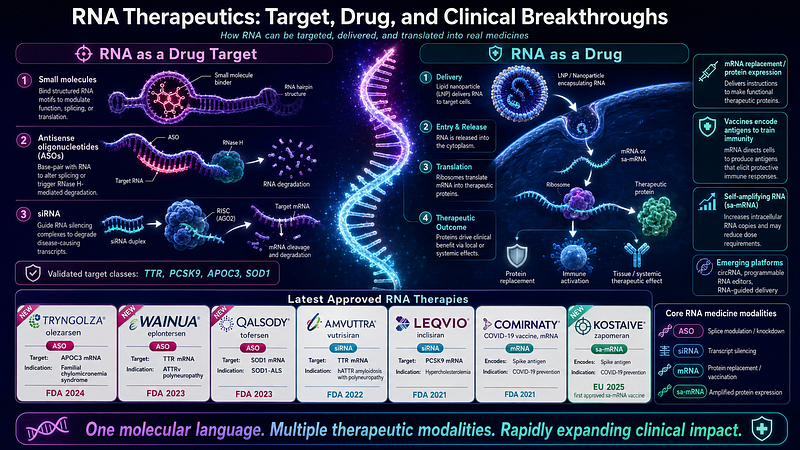
RNA is no longer just a biological intermediary. It is becoming a drug, a drug target, a vaccine platform, a gene-silencing tool, a protein-production engine, and, increasingly, a programmable therapeutic language. The COVID-19 mRNA vaccines made the world aware of RNA medicine almost overnight. But the real revolution is now happening beyond vaccines — in rare genetic diseases, cardiovascular medicine, neurology, metabolic disorders, cancer immunotherapy, and precision medicine.
The most exciting part is this: RNA therapeutics are no longer a single technology. They are becoming a family of platforms.
Antisense oligonucleotides can bind RNA and change splicing or trigger degradation. siRNAs can silence disease-causing transcripts with exquisite specificity. mRNA can instruct cells to produce therapeutic proteins or vaccine antigens. Self-amplifying RNA can copy itself inside cells and potentially lower dose requirements. Emerging circular RNA, RNA editing, and RNA-guided delivery systems could push the field even further.
The next decade of medicine may not be defined by one blockbuster RNA drug. It may be defined by the moment RNA becomes programmable.
The Two Faces of RNA Medicine
RNA therapeutics can be understood through two powerful roles.
First, RNA can be the target.
In this model, the disease-causing RNA molecule is the problem. The therapeutic goal is to bind it, block it, modify it, degrade it, or alter its processing. This is the world of antisense oligonucleotides, siRNAs, splice-switching drugs, and small molecules that bind structured RNA motifs.
Second, RNA can be the drug.
In this model, RNA is delivered into the body as the therapeutic payload. It may encode a vaccine antigen, a missing protein, a gene-editing component, or an immune-stimulating molecule. This is the world of mRNA vaccines, mRNA protein replacement, self-amplifying RNA, and potentially circular RNA medicines.
This duality is what makes RNA so strategically important. It can intervene upstream of protein expression, where disease biology begins, and it can also instruct the body to produce therapeutic proteins on demand.
In pharma terms, RNA is not just another modality. It is a platform layer.
Why the Recent Approvals Matter
The latest wave of RNA drug approvals shows that the field has matured far beyond proof of concept.
Tryngolza, the brand name for olezarsen, became a major milestone for familial chylomicronemia syndrome, a rare and serious lipid disorder marked by extremely high triglycerides and pancreatitis risk. Olezarsen is an APOC3-directed antisense oligonucleotide, showing how RNA targeting can address metabolic disease at its genetic and transcriptomic root.
Wainua, or eplontersen, represents the next generation of ligand-conjugated antisense medicines for hereditary transthyretin-mediated amyloidosis with polyneuropathy. It targets TTR mRNA, lowering production of the disease-causing transthyretin protein.
Qalsody, or tofersen, marked a major moment in neurology. It targets SOD1 mRNA in a genetically defined form of ALS. Its approval was significant not only because ALS is such a devastating disease, but because it showed how molecularly precise RNA medicines can be developed for genetically stratified neurological disorders.
Amvuttra, or vutrisiran, and Leqvio, or inclisiran, demonstrate the power of siRNA as a durable gene-silencing platform. Vutrisiran targets TTR mRNA in hereditary transthyretin-mediated amyloidosis. Inclisiran targets PCSK9 mRNA to lower LDL cholesterol, offering an infrequent dosing model that challenges the daily-pill paradigm in chronic cardiovascular prevention.
Then there is the vaccine frontier. Comirnaty and Spikevax established mRNA vaccines as a global platform during the pandemic. More recently, Kostaive, a self-amplifying mRNA vaccine, has pushed the field into a new generation of RNA vaccine design. Unlike conventional mRNA vaccines, self-amplifying RNA includes instructions for replicase, allowing the RNA to make additional copies of itself inside cells.
This is the real signal: RNA therapeutics are expanding across disease categories, delivery systems, mechanisms, and commercial models.
RNA as a Drug Target: Precision at the Transcript Level
When RNA is the target, medicines can intervene before proteins are made.
This matters because many diseases arise from abnormal gene expression, toxic gain-of-function proteins, splicing defects, or harmful transcripts. Traditional small molecules usually target proteins. Antibodies target extracellular proteins. RNA-targeted therapies act earlier in the biological cascade.
There are three major approaches.
1. Antisense oligonucleotides
Antisense oligonucleotides are short synthetic nucleic acid strands designed to bind complementary RNA sequences. Once bound, they can trigger RNA degradation, alter splicing, or block translation.
This approach is especially powerful when the disease biology is genetically defined. Tofersen for SOD1-ALS and eplontersen for ATTRv amyloidosis illustrate this logic beautifully: identify the toxic or pathogenic transcript, design an oligonucleotide to bind it, and reduce the production of the harmful protein.
2. siRNA therapeutics
siRNAs use the cell’s natural RNA interference machinery. Once incorporated into the RISC complex, the guide strand directs the complex to a matching mRNA, which is then cleaved and degraded.
The attraction of siRNA is potency and durability. With optimized chemistry and delivery, a single subcutaneous dose can produce gene silencing for weeks or months. This makes siRNA especially attractive for chronic diseases where adherence is a major barrier.
Inclisiran is a prime example. By targeting PCSK9 mRNA, it offers a long-acting strategy for LDL cholesterol reduction. Instead of asking patients to take tablets every day, RNA medicine begins to shift the model toward periodic molecular maintenance.
3. Small molecules that bind RNA
This is one of the most exciting emerging areas. RNA is not just a linear string of nucleotides; it folds into complex structures — loops, bulges, hairpins, pseudoknots, and tertiary motifs. These structures can be drugged.
Historically, small-molecule drug discovery focused on proteins because protein pockets are easier to conceptualize. But structured RNA offers a vast, underexplored target universe. If small molecules can be designed to bind disease-relevant RNA structures, the druggable genome could expand dramatically.
This is where AI could be transformative.
RNA as a Drug: Turning Cells into Temporary Bioreactors
When RNA is the drug, the therapy delivers instructions.
The classic example is mRNA vaccination. A lipid nanoparticle carries mRNA into cells. The mRNA is released into the cytoplasm. Ribosomes translate it into protein. The immune system recognizes the protein and generates protection.
But vaccines are only the beginning.
mRNA could be used to replace missing proteins, produce therapeutic antibodies, express genome-editing enzymes transiently, or stimulate immune responses against tumors. Unlike DNA-based gene therapy, mRNA does not need to enter the nucleus and does not integrate into the genome. Its transient nature can be a safety advantage.
Self-amplifying RNA adds another layer. By encoding replication machinery, sa-mRNA can increase RNA copy number inside cells, potentially achieving strong protein expression at lower doses. This may be particularly relevant for vaccines, pandemic response, and settings where dose-sparing matters.
Circular RNA is another frontier. Because circular RNA lacks free ends, it may be more stable and longer-lasting than linear mRNA. If delivery, translation efficiency, and manufacturing can be optimized, circRNA could become a next-generation protein-expression platform.
The vision is compelling: instead of manufacturing every therapeutic protein externally, deliver the genetic instruction and let the body make the medicine for a controlled period.
Delivery: The Bottleneck That Became the Battleground
RNA medicines live or die by delivery.
Naked RNA is fragile. It can be degraded by nucleases, trigger innate immune responses, or fail to reach the right tissue. The field has made huge progress with chemical modification, conjugation, and nanoparticles, but delivery remains the central engineering challenge.
The liver has been the early success story. GalNAc conjugation has enabled highly effective targeting of hepatocytes through the asialoglycoprotein receptor. This is one reason many successful siRNA and ASO programs involve liver-expressed genes.
The next frontier is extrahepatic delivery.
Can RNA be delivered efficiently to the brain, muscle, lung, immune cells, tumors, kidney, and heart? Can it cross biological barriers? Can it target specific cell types? Can it avoid unwanted immune activation? Can it be dosed repeatedly without safety issues?
The companies that solve delivery will not just create better RNA drugs. They may control the operating system for programmable medicine.
Where AI Enters the Story
AI is arriving at exactly the right time for RNA therapeutics.
RNA drug development involves enormous sequence space. A short oligonucleotide can have countless possible designs. Each design may differ in potency, specificity, stability, immune activation, chemical modification pattern, manufacturability, tissue distribution, and toxicity.
Traditional discovery relies on rational design, rules of thumb, and iterative screening. AI can compress that loop.
AI can improve target discovery
AI models can integrate genomics, transcriptomics, proteomics, single-cell data, clinical phenotypes, and disease networks to identify transcripts that are causally linked to disease. This is especially important in complex diseases where the obvious target may not be the best therapeutic node.
In precision medicine, AI can help identify patient subgroups where a transcript-level intervention is most likely to work. That could make RNA therapeutics especially powerful in genetically stratified diseases, rare disorders, and oncology.
AI can design better RNA sequences
For mRNA drugs, sequence optimization is not just about encoding the right protein. Codon usage, GC content, untranslated regions, secondary structure, modified nucleotides, degradation motifs, and translation kinetics all influence expression.
For siRNAs and ASOs, AI can help predict potency, off-target risk, tissue-specific activity, chemical modification tolerance, and durability. Instead of testing thousands of candidates blindly, companies can use models to prioritize the most promising molecules.
AI can model RNA structure
RNA folding is notoriously difficult. RNA molecules are dynamic, flexible, and context-dependent. They do not have one static shape; they exist as ensembles.
New RNA foundation models, inverse-folding tools, and generative models are beginning to attack this problem. Models such as RiboDiffusion and other RNA structure-design approaches point toward a future where scientists can design RNA sequences for desired structural and functional properties.
This matters for both sides of RNA therapeutics: designing RNA drugs and designing molecules that target structured RNA.
AI can optimize delivery systems
Lipid nanoparticles, conjugates, polymers, and targeted delivery vehicles have many tunable parameters. Lipid composition, particle size, charge, linker chemistry, ligand density, and formulation conditions all affect biodistribution and safety.
AI-driven formulation design could dramatically reduce experimental burden. Instead of trial-and-error formulation campaigns, models could predict which delivery systems are most likely to reach a target tissue with acceptable tolerability.
AI can shorten the design-build-test-learn cycle
The most important contribution of AI may not be one spectacular model. It may be workflow acceleration. RNA therapeutics are ideal for closed-loop discovery: design a molecule, synthesize it, test it, feed the data back into a model, redesign, and repeat. When connected to automated wet labs and high-throughput assays, AI can turn RNA drug discovery into an iterative learning system. This is where the field is heading: not just AI as a prediction tool, but AI as a discovery engine.
The Alnylam-Inceptive Signal: AI Moves Into RNAi
The recent strategic collaboration between Alnylam and Inceptive is an important signal for the entire sector.
Alnylam brings more than two decades of RNAi experience and proprietary siRNA data. Inceptive brings foundation models for sequence-based medicines. The collaboration aims to use AI to explore sequence space, model target mRNAs, optimize chemical modifications, and prioritize high-performing RNAi candidates.
This is not generic “AI for drug discovery” marketing. It is AI applied to a modality where sequence is the product, chemical modification is the tuning knob, and biological readouts can be fed back into model training.
That makes RNA therapeutics unusually well suited for AI-native discovery.
Proteins are complex. Cells are complex. Human biology is complex. But RNA medicines have a design logic that is closer to code than many traditional modalities. That does not make them simple. It makes them programmable enough for AI to matter.
Why Biopharma Should Pay Attention
For biopharma leaders, RNA therapeutics offer several strategic advantages. They can move rapidly once the target is known. They are modular, allowing lessons from one program to transfer to another. They can address targets that are difficult or impossible for antibodies and traditional small molecules. They can be personalized for genetically defined populations. They can support platform economics rather than one-off asset economics.
But the risks are equally real. Delivery outside the liver remains hard. Long-term safety must be understood carefully. Immunogenicity, off-target effects, manufacturing complexity, cold-chain requirements, and regulatory expectations all matter. For rare diseases, commercial models can be challenging. For chronic diseases, payer acceptance and real-world adherence will shape adoption.
The winners will not simply be companies with RNA chemistry. They will be companies that integrate target biology, delivery engineering, AI-guided design, translational biomarkers, scalable manufacturing, and patient-selection strategy.
In other words, RNA success will require platform thinking.
The Next Wave: Beyond Silencing and Vaccines
The next generation of RNA therapeutics may include:
- Personalized cancer vaccines designed from a patient’s tumor neoantigens.
- mRNA-encoded antibodies produced transiently inside the body.
- RNA editing systems that correct transcripts without permanently altering DNA.
- Circular RNA medicines with prolonged protein expression.
- Self-amplifying RNA vaccines for infectious disease and oncology.
- Small molecules that target structured noncoding RNAs.
- AI-designed siRNAs and ASOs with improved potency, safety, and tissue specificity.
- Combinatorial RNA therapies paired with gene editing, cell therapy, immunotherapy, or targeted small molecules.
This is where the field becomes truly exciting. RNA medicine is moving from single-mechanism drugs to a programmable therapeutic ecosystem.
The Big Idea: RNA Is Becoming the Software Layer of Biology
The metaphor is imperfect, but useful.
DNA is the archive. Proteins are the machinery. RNA is the executable layer.
It carries instructions, regulates timing, modulates expression, responds dynamically, and connects genotype to phenotype. If medicine can learn to write, edit, silence, amplify, and deliver RNA with precision, it gains access to one of the most powerful control layers in biology.
AI could be the compiler.
It can help translate disease biology into target hypotheses, target hypotheses into optimized sequences, sequences into molecules, and molecules into clinical candidates. It can learn from every experiment and improve the next design cycle.
The future of RNA therapeutics will not be built by biology alone or computation alone. It will be built at the intersection of both — where molecular medicine becomes programmable, data-rich, and increasingly personalized.
The first era of RNA medicine proved that RNA can work.
The second era will prove that RNA can scale.
And the third may show us something even bigger: that the most powerful drugs of the future may not be discovered in the traditional sense. They may be designed.
References
- Tryngolza / olezarsen — FDA approval, APOC3-directed ASO for familial chylomicronemia syndrome
FDA. “FDA approves drug to reduce triglycerides in adult patients with familial chylomicronemia syndrome.” December 19, 2024. - Tryngolza prescribing information
FDA AccessData. “TRYNGOLZA (olezarsen) injection, for subcutaneous use.” Approved December 2024. - Wainua / eplontersen — FDA label, ATTRv polyneuropathy
FDA AccessData. “WAINUA (eplontersen) injection, for subcutaneous use.” Initial U.S. approval 2023. - Wainua approval letter
FDA AccessData. “NDA 217388 Approval Letter — Wainua (eplontersen).” December 2023. - Qalsody / tofersen — FDA approval, SOD1-ALS
FDA. “FDA approves treatment of amyotrophic lateral sclerosis associated with a mutation in the SOD1 gene.” April 25, 2023. - Qalsody approval documentation
FDA AccessData. “NDA 215887 Approval Letter — Qalsody (tofersen).” April 2023. - Amvuttra / vutrisiran — FDA drug trial snapshot, hATTR amyloidosis polyneuropathy
FDA. “Drug Trial Snapshots: AMVUTTRA.” Approval date June 13, 2022. - Amvuttra approval letter
FDA AccessData. “NDA 215515 Approval Letter — Amvuttra (vutrisiran).” June 13, 2022. - Leqvio / inclisiran — FDA approval for LDL-C lowering
FDA. “FDA approves add-on therapy to lower cholesterol among certain high-risk adults.” December 22, 2021. - Leqvio prescribing information
FDA AccessData. “LEQVIO (inclisiran) injection, for subcutaneous use.” Initial U.S. approval 2021; updated label 2025. - Comirnaty / Pfizer-BioNTech COVID-19 mRNA vaccine
FDA. “Comirnaty.” FDA biologics product page. - Comirnaty original FDA approval
FDA. “FDA Approves First COVID-19 Vaccine.” August 23, 2021. - Spikevax / Moderna COVID-19 mRNA vaccine
FDA. “Spikevax.” FDA biologics product page. - Spikevax original approval letter
FDA. “January 31, 2022 Approval Letter — SPIKEVAX.” - Kostaive / zapomeran — EMA product page, self-amplifying mRNA vaccine
European Medicines Agency. “Kostaive.” EMA EPAR product page. - Kostaive EMA assessment report — first-in-class self-amplifying mRNA vaccine
European Medicines Agency. “Kostaive EPAR Public Assessment Report.” December 2024. - European Commission authorization for Kostaive
European Commission. “Commission Implementing Decision for Kostaive — zapomeran.” February 12, 2025. - AI and RNAi — Alnylam–Inceptive strategic collaboration
Alnylam Pharmaceuticals. “Alnylam and Inceptive Form Strategic AI Collaboration to Advance RNAi Therapeutic Discovery.” June 3, 2026. - Reuters coverage of Alnylam–Inceptive AI/RNA deal
Reuters. “Alnylam, Inceptive sign up to $2 billion AI drug discovery deal.” June 3, 2026. - RiboDiffusion — generative AI for RNA inverse folding
Huang H, Lin Z, He D, Hong L, Li Y. “RiboDiffusion: Tertiary Structure-based RNA Inverse Folding with Generative Diffusion Models.” Bioinformatics, 2024. - RNAFlow — AI for RNA structure and sequence design
Nori D, Jin W. “RNAFlow: RNA Structure & Sequence Design via Inverse Folding-Based Flow Matching.” 2024. - Review of RNA therapeutic modalities and emerging technologies
Makkar SK et al. “Advances in RNA-based therapeutics: current breakthroughs and future perspectives.” 2025. - RNA delivery challenges and solutions
Pozdniakova N et al. “RNA Therapeutics: Delivery Problems and Solutions — A Review.” 2025.
Comments ()