The Gut Microbiome Illusion: How India’s Wellness Industry Turned Complex Metagenomics Into…
Direct-to-Consumer stool testing kits promise hyper-personalized diets and medical clarity. Recent global consensus and bench validation…
The Gut Microbiome Illusion: How India’s Wellness Industry Turned Complex Metagenomics Into Marketing Theatrics
Direct-to-Consumer stool testing kits promise hyper-personalized diets and medical clarity. Recent global consensus and bench validation prove they are selling data noise.
TL;DR
Direct-to-Consumer (DTC) gut microbiome testing is experiencing a gold rush in India, packaged as the ultimate frontier of personalized wellness. However, an analysis of landmark global publications reveals that the industry’s clinical claims far outpace scientific realities. Technical variability in sequencing protocols matches actual biological variance; defining a baseline “healthy gut” remains epidemiologically impossible, and proprietary algorithms are prescribing restrictive diets based on analytical noise. This article unmasks the mechanics of this high-stakes marketing phenomenon.
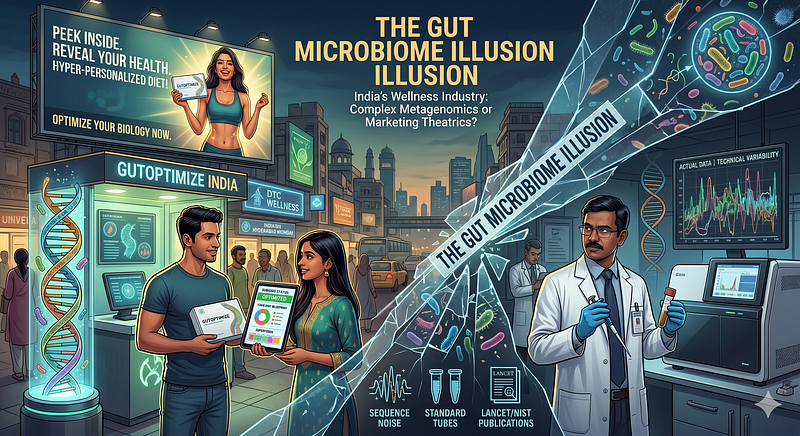
The Indian health-tech landscape is undergoing a massive paradigm shift. As metabolic syndromes, autoimmune disorders, and chronic gastrointestinal issues escalate across urban populations, consumers are actively looking for precise, preventative health tools. Seizing this opportunity, Direct-to-Consumer (DTC) gut microbiome testing companies have emerged as a premium tier of wellness optimization.
Armed with sleek packaging, glossy apps, and aggressive influencer marketing campaigns, these services promise to peek inside your colon, catalog your microbial ecosystem, and deliver a “hyper-personalized” blueprint for lifelong health. They claim to identify “dysbiosis,” optimize weight, reverse systemic inflammation, and formulate exact food lists that label regular vegetables as your personal “superfoods” or “toxins.”
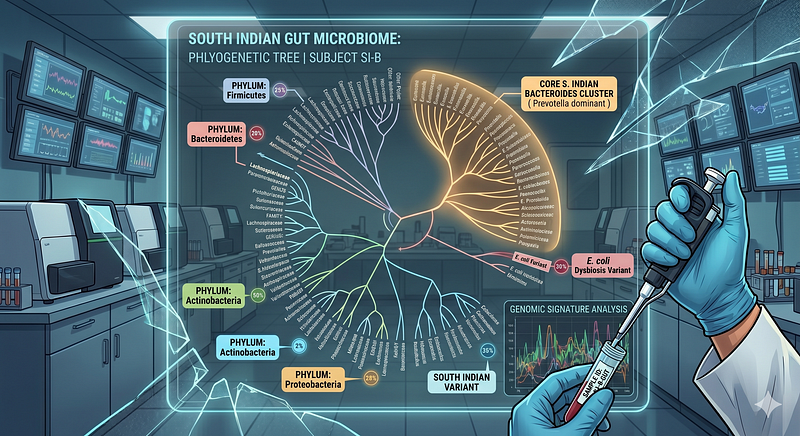
It is a compelling, high-tech narrative. But if you strip away the polished user interfaces and the algorithmic confidence, the scientific foundation is shockingly hollow. The current commercial deployment of gut microbiome testing in India appears to be more marketing than evidence-based clinical practice, with limited validation in clinical medicine and bioinformatics.
The Myth of the “Healthy Baseline” and the Illusion of Dysbiosis
The entire commercial value proposition of gut testing rests on a single, clean assumption: that science has clearly mapped what a “normal” or “healthy” gut microbiome looks like, and that any deviation from this baseline constitutes a state of “dysbiosis” that requires immediate course correction.
Global epidemiological data flatly reject this assumption. In early 2025, an exhaustive international team of researchers published the International Consensus Statement on Microbiome Testing in Clinical Practice in The Lancet Gastroenterology & Hepatology (Porcari et al., 2025). Their conclusion was unambiguous: the human microbiome is incredibly fluid, dynamic, and hyper-variable across perfectly healthy populations. Factors such as geography, genetics, micro-environments, ethnic backgrounds, and normal dietary shifts create entirely different, yet highly functional, microbial configurations.
Because there is no universally defined baseline, the term “dysbiosis” — widely used in commercial reports to alarm consumers — lacks precise clinical boundaries. A taxonomic profile flagged as “imbalanced” by an automated DTC pipeline might reflect a healthy, stable adaptation to a traditional regional Indian diet. Selling interventions to cure a non-standardized condition is a classic case of marketing therapeutics searching for a disease.
The Bench Science Nightmare: Lab Protocols as Noise Generators
Even if we overlook the epidemiological hurdles, we must confront the analytical fidelity of the tests themselves. When a consumer drops a fecal sample into a collection tube, they assume that the genomic data returned is a factual, objective inventory of their biology. It is not.
In 2024, the National Institute of Standards and Technology (NIST) led a groundbreaking study specifically designed to audit the technical performance of seven leading commercial DTC gut microbiome testing services (Servetas et al., 2024). The methodology was elegant: researchers sent identical, highly standardized human fecal reference materials to these commercial operations to evaluate consistency.
The results were alarming. The study demonstrated massive discrepancies in taxonomic profiling both across different service providers and within the same provider across different runs. Crucially, the researchers noted that:
“The analytical variability introduced by differences in DNA extraction methods, library preparation, sequencing depth, and bioinformatics pipelines was on the same scale as the actual biological variability between completely different human donors.”
Let that sink in. The data shifts wildly not because your gut biology has changed, but because the technical pipelines are highly volatile and unstandardized. If a consumer sends identical samples to two different prominent labs in India today, they are highly likely to receive entirely different microbial breakdowns and, consequently, completely contradictory lifestyle advice.
The Pseudoscience of Automated Grocery Lists
The most lucrative component of the microbiome marketing engine is the generation of personalized dietary recommendations. Consumers receive thick, digital dossiers detailing exactly what to eat. These portals leverage sophisticated scoring systems to rank ingredients, claiming that adjusting a single variable — such as substituting spinach for kale — will alter the abundance of a specific bacterial species.
This is where clinical validity completely breaks down. The translation of a taxonomic profile into a rigid dietary protocol is almost universally driven by opaque, proprietary software algorithms that are completely unvalidated by randomized controlled trials (RCTs). As highlighted in a comprehensive European review on microbiome challenges (Microbiome, 2024), acute daily diet variations, physical activity, medications, and sleep quality exert rapid, transient shifts on the gut microbiome.
A single stool snapshot cannot capture this complex, non-linear system. To claim that a static, highly variable taxonomic reading can yield an exact, mathematically precise dietary plan is not personalized medicine; it is computational astrology. It runs the very real risk of instigating orthorexia and causing nutritional deficiencies through unscientific elimination diets.
Straddling the Regulatory Void
How are these companies permitted to sell such highly predictive, health-altering insights without rigorous validation? The answer lies in deliberate regulatory arbitrage.
Globally, and within India under the Central Drugs Standard Control Organization (CDSCO) framework, commercial gut tests intentionally evade classification as “In Vitro Diagnostics” (IVDs) or medical devices. They do not claim to diagnose specific clinical conditions like ulcerative colitis or colon cancer in their fine print. Instead, they position themselves exclusively as “General Health, Wellness, and Lifestyle Optimization” tools.
This clever legal positioning allows them to avoid the mandatory, multi-phase clinical trials and independent quality audits required of medical diagnostics. It enables them to sell highly technical genomic profiles directly to consumers without medical oversight, exploiting the widespread scientific literacy gap to market commercial novelties as clinical necessities.
Conclusions: Moving from Theatrics to Science
The gut microbiome remains one of the most exciting, transformative frontiers in modern biological science. Its implications for immunology, oncology, and metabolic health are undeniable. However, the commercialization of this science has outpaced its validation by a decade.
For gut microbiome testing to establish true scientific relevance in India, the industry must pivot away from marketing theatrics and commit to rigorous fundamentals:
- Analytical Standardization: Overhauling laboratory workflows to align with strict, cross-industry reference benchmarks to eradicate technical noise.
- Indian-Specific Longitudinal Research: Abandoning Western-centric reference data in favor of massive, open-access clinical biobanks mapped across diverse Indian demographics and dietary cohorts.
- Stringent Regulatory Accountability: Implementing independent oversight to ensure that no commercial entity can issue prescriptive lifestyle or therapeutic claims without peer-reviewed, published clinical validation.
Until these criteria are met, Indian consumers and clinicians must treat commercial DTC gut profiles with intense skepticism.
A healthy gut isn't built on chasing volatile data points from unstandardized pipelines; it is maintained through the time-tested foundations of diverse nutrition, consistent physical activity, and evidence-based medicine. Don’t fall for the marketing hype.
References & Scientific Literature
- Porcari, S., Mullish, B. H., Asnicar, F., Ng, S. C., Zhao, L., Hansen, R., O’Toole, P. W., Raes, J., Hold, G., Putignani, L., Hvas, C. L., Zeller, G., Koren, O., Tun, H., Valles-Colomer, M., Collado, M. C., Fischer, M., Allegretti, J., Iqbal, T., Chassaing, B., . . . Zhang, F. (2025). International consensus statement on microbiome testing in clinical practice. The Lancet Gastroenterology & Hepatology, 10(2), 154–167.
- Rodriguez, J., Cordaillat-Simmons, M., Badalato, N., Berger, B., Breton, H., de Lahondès, R., Deschasaux-Tanguy, M., Desvignes, C., D’Humières, C., Kampshoff, S., Lavelle, A., Metwaly, A., Quijada, N. M., Seegers, J. F. M. L., Udocor, A., Zwart, H., Fasano, A., Carraturo, F., Trebicka, J., . . . Typas, N. (2024). Microbiome testing in Europe: navigating analytical, ethical and regulatory challenges. Microbiome, 12(1), 1–18.
- Servetas, S. L., Hoffmann, D., Ravel, J., & Jackson, S. A. (2024). Evaluating the Analytical Performance of Direct-to-Consumer Gut Microbiome Testing Services. bioRxiv, preprint evaluation led by the National Institute of Standards and Technology (NIST). https://pubmed.ncbi.nlm.nih.gov/41748906/
Comments ()