Beyond Minoxidil: The Next Wave of Hair-Loss Therapeutics
The emerging therapeutic landscape for androgenetic alopecia. The male pattern baldness pipeline is hot right now. After decades of being…
The emerging therapeutic landscape for androgenetic alopecia. The male pattern baldness pipeline is hot right now. After decades of being dominated by minoxidil and finasteride, a new generation of experimental therapies is targeting androgen receptors, follicle metabolism, prolactin signaling, RNA, and regenerative biology. AI may accelerate what comes next — The Next Frontier in Hair-Growth Therapeutics
TL;DR
Androgenetic alopecia — the progressive hair thinning commonly called male or female pattern hair loss — has long been treated with a surprisingly narrow pharmacological toolkit. In the United States, topical minoxidil and oral finasteride remain the established approved drug benchmarks. They can help many patients preserve or regrow hair, but treatment generally requires sustained adherence and neither drug reliably restores advanced bald scalp.
That landscape is beginning to change. Click here to read the article.
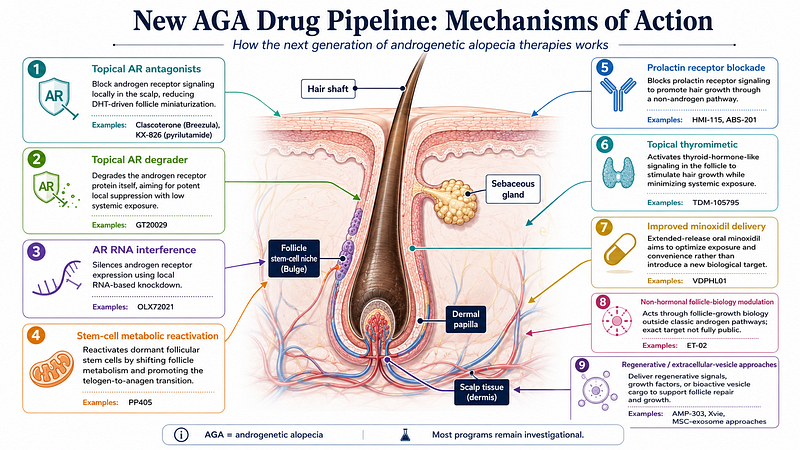
Several investigational treatments are now advancing through clinical development. Some aim to block androgen signaling more locally. One degrades the androgen receptor rather than merely antagonizing it. Others seek to reactivate dormant follicular stem cells, silence androgen-receptor expression through RNA interference, block prolactin-receptor signaling, or deliver regenerative extracellular-vesicle cargo.
The most commercially advanced programs include clascoterone, KX-826, and an extended-release oral minoxidil formulation called VDPHL01. The most mechanistically distinctive clinical programs include the topical androgen-receptor degrader GT20029, the metabolic stem-cell activator PP405, the prolactin-receptor antibodies HMI-115 and ABS-201, and the RNA-interference candidate OLX72021.
The caveat is equally important: much of the newest efficacy data remains sponsor-reported rather than fully published and independently scrutinized. The next few years should reveal whether the field is experiencing a genuine therapeutic reset — or merely a wave of promising early signals.
For a condition that affects an enormous share of the adult population, androgenetic alopecia has had a remarkably static drug-development story.
Pattern hair loss is driven by a combination of genetic susceptibility, androgen biology, follicular miniaturization, altered cycling, inflammation, fibrosis, and potentially impaired energy metabolism. Over time, thick terminal hairs become finer, shorter, and less visible. The condition affects both men and women, although its presentation differs by sex. [1]
For decades, the practical pharmacology has revolved around two familiar options: minoxidil and finasteride. These drugs are not trivial. They help many patients. Minoxidil can stimulate regrowth and improve density, while finasteride reduces dihydrotestosterone exposure by inhibiting 5-alpha-reductase. But they have limitations: adherence is indefinite, responses vary, and some patients discontinue treatment because of tolerability concerns, inconvenience, or modest benefit.
The emerging pipeline is notable because it no longer asks only one question — how can we suppress DHT or stimulate existing follicles? It is asking several more ambitious ones.
Can androgen signaling be blocked locally without meaningful systemic exposure? Can the androgen receptor itself be degraded? Can dormant follicular stem cells be metabolically reawakened? Can prolactin-receptor signaling become a therapeutic target? Can RNA therapeutics achieve durable scalp-specific knockdown? And can regenerative products be standardized well enough to become medicines rather than clinic-by-clinic procedures?
The answers are not yet known. But the clinical landscape is no longer empty.
The closest contenders: topical anti-androgens
The most advanced new therapies remain rooted in validated biology: the androgen axis.
Clascoterone: local androgen blockade moves toward the finish line
Clascoterone is a topical androgen-receptor antagonist. A 1% cream formulation is already marketed as Winlevi for acne. The investigational hair-loss formulation, commonly referred to as Breezula, is a higher-strength 5% scalp solution.
Two large Phase 3 studies, SCALP 1 and SCALP 2, evaluated twice-daily clascoterone solution against vehicle in men with androgenetic alopecia. The registered studies included a six-month efficacy phase and extended safety follow-up. [2]
Cosmo Pharmaceuticals reported positive six-month topline findings in late 2025 and subsequently announced encouraging 12-month safety and continued-growth data in April 2026. Public communications have emphasized strong relative improvement in target-area hair counts and a safety profile comparable with vehicle.
The important word is relative.
Relative improvements can sound spectacular when the placebo group changes only slightly. Before making definitive comparisons with existing therapies, clinicians and investors will need the complete absolute hair-count data, subgroup analyses, adverse-event tables, and peer-reviewed pivotal publication.
Even so, clascoterone is one of the nearest-term candidates to watch. Its strategic appeal is straightforward: block the androgen receptor locally, rather than lowering systemic androgen activity.
KX-826: an unsettled program becomes newly relevant
KX-826, also called pyrilutamide, is another topical androgen-receptor antagonist. Its development story has been more complicated.
Earlier studies produced mixed interpretations, particularly when investigators and observers compared placebo-adjusted efficacy across geographies, doses, and trial designs. But Kintor Pharmaceutical reported a significant update in March 2026: the Phase 3 stage of its pivotal China trial for KX-826 1.0% tincture met its primary endpoint, with what the company described as statistically significant and clinically meaningful results. [3]
Kintor presented the Phase 3 dataset and combination-treatment observations at the World Congress for Hair Research in Seoul in May 2026, where the pivotal trial presentation was selected as an outstanding poster.
This does not eliminate the need for scrutiny. The complete pivotal dataset, absolute effect size, durability, safety tables, regulatory pathway outside China, and reproducibility across populations remain important diligence questions.
But KX-826 can no longer be treated as a marginal footnote. It is now one of the central competitive assets in late-stage AGA development.
A more elegant androgen strategy: destroy the receptor
The most conceptually interesting androgen-axis program may be GT20029.
Instead of blocking the androgen receptor or reducing DHT formation, GT20029 is designed to degrade the androgen receptor protein itself using a targeted protein-degradation approach. It is often described as a topical AR-PROTAC.
That distinction matters.
A receptor antagonist competes for binding. A degrader aims to remove the protein from the cellular system. In principle, a topical degrader could deliver sustained local pharmacology with relatively infrequent administration while limiting systemic exposure.
A registered Phase 2 study enrolled 180 men with androgenetic alopecia and tested several dosing regimens over 12 weeks. [4] A peer-reviewed publication reported significant improvements in hair-growth measures with favorable tolerability and identified a 1% twice-weekly regimen as a particularly promising schedule for further development. [5]
GT20029 is not yet a proven replacement for established therapy. Larger and longer studies are needed. But it is a clean example of how modern drug-discovery modalities can revisit a validated target and potentially improve the therapeutic profile.
The real paradigm shift: reactivate dormant follicles
If the androgen-axis programs represent an effort to attack a familiar target more precisely, PP405 represents a different philosophy.
PP405: targeting follicular metabolism
PP405 is a topical small molecule developed by Pelage Pharmaceuticals. Its goal is not primarily to suppress androgen signaling. Instead, it is designed to reactivate dormant hair-follicle stem cells by modulating metabolic pathways associated with the transition between quiescence and active growth.
The Phase 2a study, registered as NCT06393452, included men and women with androgenetic alopecia and evaluated topical PP405 against vehicle. [6]
Pelage reported positive preliminary findings in June 2025. According to the company, PP405 showed no detectable systemic absorption in blood. In an exploratory subgroup of men with more advanced hair loss, 31% of treated participants achieved a greater than 20% increase in hair density at week eight, compared with none receiving vehicle. Pelage also reported new terminal-hair growth from previously dormant follicular units.
These are intriguing findings, but the evidentiary boundaries matter.
The responder group was limited. The public dataset remains incomplete. Durability is unknown. Female efficacy needs clarification. It is not yet clear whether a biomarker can identify likely responders or whether the observed signal will reproduce in a larger pivotal trial.
Still, PP405 may be the most important non-androgen small-molecule program in the current pipeline. If the biology holds, it could shift the field away from pure maintenance and toward functional reactivation.
A new antibody class: prolactin-receptor blockade
One of the most interesting developments in the AGA landscape is the emergence of prolactin-receptor blockade as a therapeutic strategy.
HMI-115: the clinical proof-of-concept pioneer
HMI-115, also known as BAY1158061, is an anti-prolactin-receptor monoclonal antibody licensed by Hope Medicine.
Hope Medicine reported results from a small open-label Phase 1b study in Australia involving 12 men and four women with androgenetic alopecia. After 24 weeks, the company reported an average increase of 14 non-vellus hairs per square centimeter among the 12 male participants, with favorable tolerability. [7]
A larger randomized, double-blind, placebo-controlled Phase 2 study in men is registered as NCT06118866. [8] The public registry indicates that the study has been completed, but a detailed public Phase 2 efficacy package has not yet surfaced.
This makes HMI-115 both important and difficult to evaluate. It offers an early human signal in a genuinely different biological pathway, but the field needs the controlled Phase 2 dataset.
ABS-201: AI-designed competition enters the clinic
ABS-201 is an anti-prolactin-receptor antibody designed by Absci using an AI-enabled drug-discovery platform.
The first-in-human HEADLINE study is registered as NCT07317544 and is evaluating single and multiple ascending doses in healthy volunteers and participants with androgenetic alopecia. [9]
In May 2026, Absci reported that it had dosed all four planned healthy-volunteer single-ascending-dose cohorts and initiated the first multiple-ascending-dose cohort in participants with AGA. The company said the antibody had been well tolerated to date and that preliminary pharmacokinetic modeling supported a target dosing interval of two or three injections over six months. Interim proof-of-concept data are expected in the second half of 2026. [10]
ABS-201 has not yet demonstrated human efficacy.
But its significance extends beyond hair loss. It is a live clinical experiment in whether AI-enabled biologics design can compress the path from target hypothesis to optimized development candidate — and potentially create an infrequently dosed therapy in a field historically dominated by daily pills and topical applications.
Silencing the receptor with RNA
Another modern modality is moving through early clinical development.
OLX72021, formerly referred to as OLX104C, is an RNA-interference therapeutic developed by OliX Pharmaceuticals. It is designed to reduce androgen-receptor expression through an asymmetric siRNA approach.
An Australian Phase 1 study evaluated intradermal scalp injections of OLX72021. A multiple-dose Phase 1b/2a study is now registered and recruiting. [11]
The key commercial questions are not only scientific.
Will scalp injections be acceptable to patients? How long will receptor knockdown last? How frequently will treatment be required? Can local exposure be sustained while systemic exposure remains minimal? And can manufacturing costs support a broad-market aesthetic or dermatological product?
OLX72021 is early. But it demonstrates how far the field has moved beyond conventional small molecules.
The underappreciated middle: better formulation and alternative biology
Not every commercially relevant program needs a new target.
VDPHL01: reformulating oral minoxidil
VDPHL01 is an extended-release oral minoxidil formulation developed by Veradermics. Oral minoxidil is already widely prescribed off-label for hair loss, but it was not originally designed as a hair-growth drug and can produce systemic exposure patterns that require careful clinical management.
Veradermics is conducting three randomized Phase 3 studies in men and women with pattern hair loss. The company has completed enrollment in both male studies and reported positive preliminary topline findings from the first male study in April 2026. [12]
VDPHL01 is not a discovery-biology story. It is a formulation and product-development story. But if its pharmacokinetic profile, efficacy, and cardiovascular safety are persuasive, it may become commercially important because it targets a familiar clinical practice with a purpose-built product.
TDM-105795: a topical thyromimetic
TDM-105795 is a topical small molecule from TechnoDerma Medicines. The company describes it as a potent thyromimetic intended to stimulate hair growth with low systemic exposure.
A registered Phase 2a study included 71 men with androgenetic alopecia. TechnoDerma reported mean increases in non-vellus target-area hair counts of 24.3 hairs for the 0.02% formulation, 20.3 hairs for the 0.0025% formulation, and 14.0 hairs with vehicle in one-square-centimeter test areas after once-daily dosing. [13]
The signal is worth tracking, but it needs confirmation in a larger study with longer follow-up and a careful thyroid-axis safety assessment.
ET-02: promising early data, but keep the comparisons honest
ET-02, also called RS5441, is a topical program developed by Eirion Therapeutics and licensed from ReNA Science.
In a small double-blind, placebo-controlled, dose-ranging Phase 1 study, 24 participants received vehicle, 1.25% ET-02, or 5% ET-02 once daily for four weeks. The company reported that the 5% group showed a sixfold increase in non-vellus hair count compared with the combined lower-dose and vehicle comparator group at week five, alongside an increase in hair width. [14]
Those results are interesting, but historical comparisons with minoxidil should not be mistaken for a head-to-head trial. A larger controlled study is needed before drawing strong efficacy conclusions.
The regenerative frontier: exciting, heterogeneous, and easy to overstate
The regenerative category has the highest theoretical ceiling and the weakest standardization.
AMP-303: an injectable feasibility signal
Amplifica has reported early human findings for AMP-303, a novel intradermal injectable polysaccharide treatment. The company presented first-in-human feasibility results at the Society for Investigative Dermatology annual meeting in 2025. [15]
Amplifica reported increases in non-vellus hair count and evidence of sustained improvement after a single treatment cycle. The public dataset remains limited, and the field still needs full numerical results, replication, repeat-dosing data, and clarity around composition and manufacturing controls.
Xvie: extracellular-vesicle therapy enters formal development
Xvie is an injectable product derived from processed human amniotic fluid and described as containing growth factors and extracellular vesicles.
A registered study, NCT07482423, is designed to enroll 30 adults with androgenetic alopecia and compare Xvie injections with saline placebo in two treatment sessions separated by 90 days. [16]
That trial matters because extracellular-vesicle products have often existed in a regulatory gray zone, with heterogeneous compositions and uneven evidence standards. A prospectively registered, controlled study is a necessary step toward determining whether this category can become reproducible medicine.
Exosome preprints: promising signals, low certainty
A recent Research Square preprint described a 12-patient Phase 1/2 study of placenta-derived mesenchymal-stem-cell exosomes injected into the scalp every 14 days for two months. The authors reported increased hair density and diameter and reduced shedding. [17]
But the study was small, lacked a control group, had short follow-up, and has not yet undergone peer review.
This is exactly where the field needs discipline. “Exosomes” are not a single standardized drug class. Different products may contain different vesicle populations, proteins, lipids, nucleic acids, contaminants, and manufacturing signatures. Results from one preparation should not be generalized to another.
SCUBE3, osteopontin, and follicle engineering
Preclinical work has identified regenerative signals such as SCUBE3, a dermal-papilla-associated signaling molecule linked to active hair growth. [18]
Other groups are exploring osteopontin, Wnt signaling, wound-induced follicle neogenesis, follicle banking, cell therapy, and induced-pluripotent-stem-cell approaches to engineer new follicular units.
These concepts are scientifically important. They are not yet near-term clinical products.
Where AI can make a real difference
Hair-loss drug discovery is an unusually good test case for applied AI because the biology is multidimensional but experimentally accessible.
A productive AI program should not begin with a chatbot generating target lists. It should begin with a structured evidence graph.
That graph would connect:
- genetic associations;
- androgen-response pathways;
- dermal-papilla signaling;
- follicular stem-cell quiescence;
- inflammatory and fibrotic pathways;
- scalp spatial transcriptomics;
- single-cell RNA sequencing;
- proteomic and metabolomic signatures;
- longitudinal trichoscopy images;
- treatment-response phenotypes;
- adverse-event data;
- patent claims;
- clinical-trial endpoints;
- and competitive-development timelines.
From there, AI can accelerate several steps.
1. Find underexploited targets
Machine-learning systems can integrate omics datasets and identify convergent nodes that sit downstream of multiple disease pathways. The best targets may not be the most obvious ones. A pathway that links androgen sensitivity, energy metabolism, fibrosis, and stem-cell quiescence could produce a more differentiated program than another conventional DHT blocker.
2. Match modality to biology
Some targets are best approached with topical small molecules. Others may require antibodies, degraders, RNA therapeutics, or regenerative products. AI-assisted tractability models can help determine whether a target is druggable, whether scalp-localized delivery is feasible, and which modality offers the best balance of durability, cost, and systemic safety.
3. Design better molecules faster
GT20029 shows how a modern modality can revisit an old target. ABS-201 goes further: it is testing whether AI-designed antibodies can produce a clinically viable profile with infrequent dosing.
Generative models can help optimize affinity, selectivity, developability, immunogenicity risk, pharmacokinetics, formulation, and manufacturability before a candidate enters the clinic.
4. Identify responders early
The future of AGA treatment may not be one universal drug. It may be a response-stratified system.
AI models could combine scalp imaging, hair-shaft measurements, genetic profiles, hormonal context, disease stage, age, sex, and molecular biomarkers to identify which patients are most likely to respond to androgen blockade, stem-cell reactivation, prolactin-receptor inhibition, or combination therapy.
That could be particularly important for PP405-like programs, where an early responder signal may be biologically meaningful but not evenly distributed across the population.
5. Improve clinical endpoints
Hair-growth trials are laborious, image-intensive, and vulnerable to measurement variability.
Computer-vision systems can standardize target-area hair counts, distinguish terminal from vellus hairs, quantify shaft width, track follicular-unit activity, and detect subtle longitudinal changes. Better digital phenotyping could reduce noise, improve statistical power, and make smaller proof-of-concept trials more informative.
6. Design rational combinations
The most powerful future regimen may not be a single agent.
A plausible combination strategy could pair local androgen suppression with follicular reactivation. Another could combine a durable systemic or injectable biologic with a topical therapy used intermittently. AI models can help prioritize combinations by mechanistic complementarity, dosing compatibility, and safety constraints before expensive clinical testing.
The next chapter is not a miracle cure
The hair-loss field is entering a more serious phase of drug development.
The most advanced assets could broaden the therapeutic menu. The most novel assets could change the biological framework. And AI could shorten the distance between a plausible pathway and a clinically testable molecule.
But the standard of evidence must remain high.
A sponsor-reported topline result is not a regulatory approval. A statistically significant hair-count change is not automatically a cosmetically meaningful transformation. A preprint is not a validated therapy. A regenerative product is not interchangeable with every other product marketed under the same category.
The real opportunity is larger than hype.
After decades of limited pharmacological innovation, androgenetic alopecia is becoming a proving ground for targeted protein degradation, RNA therapeutics, metabolic stem-cell activation, AI-designed antibodies, regenerative medicine, and precision clinical phenotyping.
The most important outcome may not be a single blockbuster treatment.
It may be the emergence of a new model: hair loss treated not as a cosmetic afterthought, but as a biologically stratified disease with multiple actionable pathways — and a pipeline sophisticated enough to match them.
Citations:
[1] AGA biology and standard-of-care context. Recent reviews describe AGA as a multifactorial condition involving genetic predisposition, androgen metabolism, inflammation, fibrosis, and impaired energy metabolism; established therapy remains centered on minoxidil and finasteride.
[2] Clascoterone / Breezula. The two pivotal SCALP studies are registered as NCT05910450 and NCT05914805. Each evaluates clascoterone solution against vehicle, including a six-month efficacy phase and longer safety follow-up.
[3] KX-826 / pyrilutamide. Kintor’s March 18, 2026, official announcement states that the Phase 3 stage of the pivotal 1.0% tincture study reached its primary endpoint; the company’s June 1 update describes the WCHR 2026 presentation. The long-term safety study is registered as NCT06126965.
[4] GT20029 Phase 2 registry. The registered study, NCT06692465, enrolled 180 adult men with AGA and tested multiple dose-frequency groups.
[5] GT20029 peer-reviewed publication. Hu and colleagues reported efficacy and tolerability findings for topical GT20029 in male AGA.
[6] PP405. The Phase 2a study is registered as NCT06393452. Pelage’s June 17, 2025, announcement describes the preliminary clinical signal and the stem-cell-reactivation hypothesis.
[7] HMI-115 Phase 1b sponsor disclosure. Hope Medicine reported an Australian open-label study involving 12 men and four women and described the male target-area hair-count result.
[8] HMI-115 Phase 2 registry. The randomized male AGA study is registered as NCT06118866.
[9] ABS-201 HEADLINE trial. The first-in-human study is registered as NCT07317544.
[10] ABS-201 official company update. Absci’s May 7, 2026, investor update reports completion of the planned healthy-volunteer single-ascending-dose cohorts, initiation of multiple-dose AGA dosing, favorable emerging tolerability, and preliminary pharmacokinetic modeling.
[11] OLX72021. The Australian single-dose study is listed in ANZCTR, and the multiple-dose Phase 1b/2a program is publicly described as evaluating safety, tolerability, pharmacokinetics, and efficacy in men with AGA.
[12] VDPHL01. Veradermics describes three randomized Phase 3 studies and reports completed enrollment in both male studies with preliminary topline findings from the first male study. The female study is registered as NCT07146022.
[13] TDM-105795. The Phase 2a study is registered as NCT05802173. TechnoDerma’s announcement describes the 71-participant proof-of-concept study and reported target-area hair-count changes.
[14] ET-02 / RS5441. ReNA Science’s disclosure describes the 24-participant Phase 1 study, while Eirion’s public pipeline page identifies ET-02 and ET-03 as topical and oral small-molecule programs. The reported comparison with minoxidil is historical rather than head-to-head.
[15] AMP-303. Amplifica’s official announcement describes the first-in-human randomized feasibility study and the SID 2025 poster presentation.
[16] Xvie. The investigational extracellular-vesicle-containing injectable is registered as NCT07482423.
[17] Placenta-derived MSC exosome preprint. This Research Square manuscript reports a small uncontrolled 12-patient study and explicitly states that it has not undergone journal peer review.
[18] Regenerative and emerging-target review. A recent review summarizes newer approaches including SCUBE3, regenerative concepts, RNA therapeutics, and clinical-stage hair-loss assets.
Comments ()