AlphaEvolve: The AI That Rewrites Its Own Algorithms — And May Reshape Science Forever
Google DeepMind’s evolutionary coding agent just repaired DNA sequencing, redesigned quantum circuits, and cracked a 56-year-old…
Google DeepMind’s evolutionary coding agent just repaired DNA sequencing, redesigned quantum circuits, and cracked a 56-year-old mathematics problem. Here’s what scientists need to know.
Click here to read if you are stuck behind a paywall
TL;DR — AlphaEvolve (Google DeepMind, May 2025)
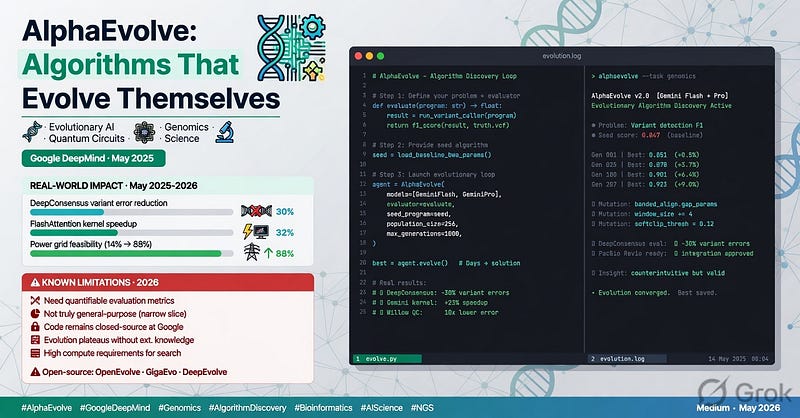
AlphaEvolve is an evolutionary coding agent that uses Gemini Flash + Pro in a closed loop to autonomously discover and improve algorithms — evolving entire codebases, not just single functions. You give it a problem, a seed algorithm, and a scoring function; it runs Darwin on your code until it finds something better.
What it’s actually done:
- Genomics: 30% reduction in variant detection errors in PacBio’s DeepConsensus model — coming to Revio instruments
- Quantum: 10× lower error on Willow quantum circuits for molecular simulations
- Math: Rediscovered state-of-the-art on 75% of open math problems; improved on 20% — including beating Strassen’s 1969 matrix algorithm
- Google infra: 0.7% global compute recovered, 23% Gemini kernel speedup, TPU circuit adopted into silicon
The catch: It only works where you have a clean, automated scoring metric. No metric = no AlphaEvolve. It’s powerful but narrow, and the code is closed-source.
How to access it: Google Cloud Early Access Program (contact your GCP rep) or the academic interest form on the DeepMind blog. Open-source alternatives: OpenEvolve, GigaEvo, DeepEvolve.
Bottom line for genomics/bioinformatics: If you have a pipeline with a quantifiable evaluation metric (F1, precision/recall, alignment score), AlphaEvolve is worth serious attention. The DeepConsensus result alone proves it can operate at clinical-grade impact.
May 2026 · 16 min read
Here’s something that should pause every researcher staring at an intractable optimization problem.
You’ve spent months — sometimes years — crafting the best algorithm you know how to build. You’ve tuned every parameter, consulted every paper, benchmarked every variant. And then an AI walks in over a long weekend and finds a solution your entire team missed, one so counterintuitive that a Google engineer described it as something that “shouldn’t work but does.”
That’s not speculation. That’s AlphaEvolve.
On May 14, 2025, Google DeepMind announced AlphaEvolve, an evolutionary coding agent that autonomously discovers and refines algorithms by combining the creative power of large language models with relentless automated evaluation. In the year since, it has quietly become one of the most consequential scientific tools of the decade — improving DNA sequencing accuracy, optimizing power grids, helping run quantum chemistry simulations on Google’s Willow processor, and advancing mathematical problems that had stumped humanity for over half a century.
But is it really the “spectacular, general-purpose science AI” that Nature’s headline declared? Or are we watching another cycle of breathless AI hype? The answer, as with most things in science, is more interesting than either extreme.
What AlphaEvolve Actually Is — And What It Isn’t
Let’s start with the architecture, because the engineering here is elegant.
AlphaEvolve is not a chatbot that writes code on request. It is a closed evolutionary loop that continuously improves algorithms by treating code as evolvable genetic material.
Here is how it works, step by step:
- You define the problem. You provide a problem specification, an evaluation function (the “fitness test”), and a seed program — a working but suboptimal starting algorithm. The key constraint: your problem must be objectively measurable. If you can score a solution automatically, AlphaEvolve can search it.
- Two Gemini models run in tandem. Gemini Flash maximizes breadth — generating many diverse mutations quickly. Gemini Pro provides depth — fewer but more insightful suggestions. Together they act as a creative mutation engine.
- Programs are evaluated, scored, and stored in a continuously updated database. High-scoring candidates become parents for the next generation. Low scorers are discarded. Sound familiar? It’s Darwinian selection applied to code.
- The loop runs until it converges on a solution significantly better than anything you started with.
The elegance of this approach is also its key limitation: AlphaEvolve can only work where progress can be clearly and quantitatively measured. You need a ground-truth evaluator. This rules out qualitative problems, problems without objectively verifiable answers, and domains where “better” is hard to define. As NYU computer scientist Ernest Davis wrote in a pointed analysis, AlphaEvolve is more accurately described as an automated optimization agent than a “general-purpose science AI” — a useful distinction for managing expectations. The Nature headline calling it “spectacular general-purpose science AI” was, Davis argued, the exact opposite of accurate.
Simon Frieder, an AI researcher at the University of Oxford, made a similar point: AlphaEvolve will likely be applied only to “a narrow slice of tasks that can be presented as problems to be solved through code.” That’s still an enormously valuable slice. But scientists considering this tool need to enter with clear eyes.
“AlphaEvolve is not making breakthrough discoveries. It is finding improvements in territories already mapped by human experts.” — TechCrunch, May 2025
The Scorecard: What AlphaEvolve Has Actually Done
Forget the hedges for a moment. The real-world deployments are remarkable.
⚙️ Reinventing Google’s Own Infrastructure
This is where AlphaEvolve’s impact is most concrete and verifiable. Over the past year, its algorithms have been deployed in production across Google’s global computing ecosystem:
- Data centers: AlphaEvolve found a scheduling heuristic for Borg, Google’s fleet-wide workload orchestration system, that continuously recovers an average of 0.7% of Google’s total global compute capacity. At Google’s scale, that fraction represents millions of machines worth of headroom freed every day — and it outperformed a solution that had been generated by deep reinforcement learning.
- TPU chip design: AlphaEvolve proposed modifications to Verilog circuit designs that eliminated redundancies in a critical arithmetic circuit used for matrix multiplication. The proposal was so sound it was directly incorporated into Google’s next-generation Tensor Processing Units. In the words of Jeff Dean, Chief Scientist at Google DeepMind: “It proposed a circuit design so counterintuitive yet efficient that it was integrated directly into the silicon of our next-generation TPUs.”
- AI training speed: AlphaEvolve found a smarter way to partition large matrix multiplication operations — a foundational step in almost all AI inference and training. Result: a 23% speedup in a critical Gemini architecture kernel, translating to a 1% reduction in total Gemini training time. For a model that takes weeks to train on thousands of chips, 1% is not trivial. It also achieved a 32.5% speedup in the FlashAttention kernel used in Transformer-based models.
- Spanner database: According to a recent update, AlphaEvolve achieved a 20% reduction in write amplification in Google’s globally distributed Spanner database.
🧬 Genomics: The Result Closest to Clinical Impact
This is the development that should capture every genomics researcher’s attention.
AlphaEvolve was applied to DeepConsensus, Google’s transformer-based model for correcting errors in PacBio HiFi long-read sequencing data. The system identified and optimized the banded alignment components — refining both implementation and parameterization — to achieve a 30% reduction in variant detection errors.
For context: these are the exact errors that can determine whether a clinician correctly identifies a pathogenic variant in a diagnostic whole-genome sequence. PacBio’s Aaron Wenger (Senior Director) stated directly: “This higher-quality data might enable the discovery of previously hidden disease-causing mutations.”
An upcoming Revio instrument update is expected to incorporate these improvements, meaning the impact will reach sequencing labs globally. For researchers running WGS, WES, or long-read panel workflows — this is not an academic improvement. It will affect real clinical calls.
🔢 Mathematics: Cracking Problems That Stood for Decades
AlphaEvolve was benchmarked on over 50 open mathematical problems spanning geometry, combinatorics, number theory, and mathematical analysis — a collection curated with input from Fields Medal–level mathematicians including Terence Tao.
The results:
- 75% of the time, AlphaEvolve rediscovered the current state-of-the-art solution
- 20% of the time, it discovered a solution that improved upon the best known result
Notable achievements include:
- Matrix multiplication: Found a new algorithm for multiplying 4×4 complex-valued matrices using just 48 scalar multiplications, beating Strassen’s 1969 algorithm (49 multiplications) and AlphaTensor’s earlier result
- Kissing number problem (11D): Discovered 593 non-overlapping unit spheres touching a central sphere — a new record, up from the previous 592
- Erdős minimum overlap problem: Set a new upper bound in number theory for a problem that dates back to the 1950s
- Autocorrelation inequalities: Improved bounds in mathematical analysis, areas relevant to signal processing
Working with Terence Tao, who described these tools as giving mathematicians “very useful new capabilities,” the system demonstrated that AI can serve as a genuine mathematical research partner — not just a pattern matcher.
⚡ Beyond Computing: Earth, Energy, and Quantum
In a May 2026 impact update, Google DeepMind revealed several additional breakthroughs:
- Power grids: Applied to the AC Optimal Power Flow problem, AlphaEvolve improved the ability of a trained Graph Neural Network to find feasible grid solutions from 14% to over 88% — a transformative result for energy system simulation.
- Disaster prediction: By automating optimization of Earth AI models used in geospatial analysis, overall accuracy of natural disaster risk prediction across 20 hazard categories (wildfires, floods, tornadoes) improved by 5%.
- Quantum physics: AlphaEvolve optimized quantum circuits for molecular simulations on Google’s Willow quantum processor, achieving 10× lower error rates than conventionally optimized baselines — enabling first-of-a-kind experimental demonstrations in quantum chemistry.
- Neuroscience: New optimizations have helped unlock insights in neural simulation workflows, though specific details remain limited in current public disclosures.
How Scientists Can Use AlphaEvolve Right Now
This is the practical section that most coverage omits. Access is real but gated.
Route 1: Google Cloud Early Access Program
As of December 2025, AlphaEvolve is available through Google Cloud in private preview. The AlphaEvolve Service API is accessible through an Early Access Program. Enterprise or research teams can reach out to their Google Cloud representative to express interest.
What you need to bring:
- A problem specification (what you’re trying to optimize)
- An evaluation function — this is the critical piece. You must be able to score candidate solutions automatically and objectively
- A seed initialization program: a working but suboptimal algorithm in Python or another supported language
Best fit problems from a biology/life sciences perspective:
- Molecular simulation algorithms: Optimizing force fields, integration schemes, or energy minimization routines
- Variant calling pipeline parameters: Any optimization problem where the metric is precision/recall on a validated callset
- Protein stability or folding algorithms: Where you can score thermodynamic properties automatically
- Drug screening scoring functions: If you have a docking or QSAR pipeline with a clear objective metric
- Bioinformatics alignment parameters: Especially for long-read data where there’s room to improve banded alignment approaches (as the DeepConsensus case demonstrated)
Route 2: Academic Early Access
Google DeepMind has set up an academic early access form for researchers who want to experiment with AlphaEvolve on open scientific problems. Priority appears to be given to problems with clean, quantifiable evaluation metrics in mathematics and computational science.
Route 3: Open-Source Reproductions
Because Google has not released AlphaEvolve’s code, the community has built independent implementations:
- OpenEvolve (Sharma, 2025) — the most widely cited open-source AlphaEvolve reproduction
- GigaEvo — modular, concurrent open-source framework with benchmarked reproducibility
- ThetaEvolve — simplified single-LLM variant optimized for test-time compute scaling
- DeepEvolve — augments evolution with deep research retrieval, addressing AlphaEvolve’s internal knowledge plateau
These tools let you run AlphaEvolve-style experiments with open-weight models (Llama, Qwen, Mistral) on your own hardware. For computational biologists with a cluster and a well-defined optimization target, this is worth exploring now.
The Honest Scorecard: Pros and Cons
✅ What AlphaEvolve Gets Right
Hallucination control by design. Standard LLMs confidently generate wrong answers. AlphaEvolve’s automated evaluators filter hallucinations structurally — only code that passes your evaluation metric survives. This is not a post-hoc filter; it’s baked into the architecture.
Full-codebase evolution. Previous systems like FunSearch could only evolve single functions. AlphaEvolve can evolve entire programs, making it applicable to far more complex engineering problems.
Human-AI collaboration, not replacement. In every production deployment documented so far, AlphaEvolve has worked alongside domain experts. The chip team validated its Verilog suggestions; the genomics team reviewed the DeepConsensus changes. The AI proposes; humans evaluate and integrate.
Breadth at scale. Gemini Flash explores widely while Gemini Pro dives deep — an ensemble approach that covers both local and global optimization search.
Self-improving trajectory. AlphaEvolve helped optimize the training of the very Gemini models that power it. There is a genuine feedback loop: better models yield better algorithm discovery, which yields better AI training, which yields better models.
❌ What AlphaEvolve Gets Wrong (Or At Least Incomplete)
Narrow problem class. Despite DeepMind’s “general-purpose” framing, AlphaEvolve only works on problems with automated, quantitative evaluation. It cannot help with hypothesis generation in ambiguous domains, qualitative scientific reasoning, or experimental design. Davis’s critique is valid: this is not general-purpose science AI.
Closed source. The technical paper (arXiv 2506.13131) provides methodological detail, but AlphaEvolve’s code is not publicly available. DeepMind has a pattern of releasing high-profile papers without full training scripts or implementations (see AlphaFold 2 without training code, AlphaGeometry with reproducibility bugs). The community has responded with open-source alternatives, but the originals remain internal.
Evolution plateau. Research from the DeepEvolve team (arXiv 2510.06056) demonstrates a clear limitation: pure algorithm evolution “depends only on the internal knowledge of LLMs and quickly plateaus in complex domains.” Without external knowledge grounding, AlphaEvolve runs out of novel ideas as search continues. This is a fundamental architectural constraint, not a bug.
Requires expert problem formulation. The hardest part of using AlphaEvolve is defining the evaluation function correctly. A poorly designed fitness metric leads to solutions that score well but solve the wrong problem — a manifestation of Goodhart’s Law. This places the burden of rigorous problem specification on the human researcher.
No uncertainty quantification. The system tells you what the best algorithm it found is — not how confident it is, or how close to a global optimum the solution might be. For scientific use cases where reproducibility and error quantification matter, this is a meaningful gap.
Compute intensive. Running an AlphaEvolve-style evolutionary search requires substantial GPU/TPU resources. For academic labs without cloud credits or large clusters, the open-source alternatives face real computational barriers.
The Bigger Picture: Where AlphaEvolve Fits in the AI-for-Science Stack
AlphaEvolve is not AlphaFold. It will not trigger a revolution in one specific domain — it is infrastructure-level technology that operates across domains wherever algorithms can be evolved.
A useful mental model: AlphaFold gave you a map of protein space. AlphaEvolve gives you a more efficient engine for navigating any algorithmic search space you can define.
In genomics, this means better base-calling, better alignment, better variant calling. In structural biology, it means faster molecular simulation. In clinical trials, it may eventually mean better patient stratification algorithms. In quantum computing, it means circuit design that exceeds what human engineers would attempt.
The key insight from the past year of deployments is this: AlphaEvolve is most powerful when plugged into an existing AI pipeline that already has well-defined evaluation metrics. DeepConsensus had them. Gemini’s training kernels had them. The AC Optimal Power Flow problem had them. Your NGS variant calling pipeline almost certainly has them too.
Your Action Items — Start Here
Immediate (< 10 minutes)
- [ ] Read the AlphaEvolve technical paper (Novikov et al., 2025) — essential background
- [ ] Explore the DeepMind impact blog for the latest real-world case studies
- [ ] Bookmark the Google academic early access form to register interest
This Week
- [ ] Identify one optimization problem in your pipeline with a clear, automatable evaluation metric — this is your AlphaEvolve candidate
- [ ] Set up OpenEvolve or GigaEvo locally and run the benchmark examples to understand the workflow before you apply it to your own data
- [ ] Read the DeepEvolve paper if you work in a domain where external literature grounding matters — their augmented approach addresses AlphaEvolve’s plateau problem
Ongoing
- [ ] Follow the Google Cloud AlphaEvolve early access program for commercial availability updates
- [ ] Track open-source ecosystem development — the gap between closed AlphaEvolve and open reproductions is narrowing rapidly
- [ ] For genomics labs running PacBio HiFi workflows: watch for the upcoming Revio firmware update incorporating the AlphaEvolve-improved DeepConsensus model
Key Resources
Official Documentation & Papers
- 📘 AlphaEvolve — Google DeepMind Blog
- 📘 AlphaEvolve Impact Update — Google DeepMind
- 📘 AlphaEvolve on Google Cloud — Private Preview
- 📄 AlphaEvolve paper: arXiv 2506.13131 — Novikov et al.
Genomics Coverage
- 🧬 PacBio: Improving HiFi Sequencing with AlphaEvolve
- 📄 DeepConsensus original paper — Nature Biotechnology
Critical Analysis
- 📄 Ernest Davis — NYU: Comments on AlphaEvolve
- 📄 TechCrunch: DeepMind’s AlphaEvolve claims and caveats
Open-Source Alternatives
- 🛠️ GigaEvo — extensible open-source reproduction (arXiv 2511.17592)
- 🛠️ DeepEvolve — augmented evolution with deep research (arXiv 2510.06056)
- 🛠️ Mathematical exploration with AlphaEvolve (arXiv 2511.02864 — includes Terence Tao)
Research Papers
- 📑 AlphaEvolve technical report (arXiv 2506.13131)
- 📑 Mathematical Exploration and Discovery at Scale (arXiv 2511.02864)
Before You Go
The arrival of AlphaEvolve signals something important: we are entering an era where the bottleneck in scientific computing is no longer compute power or even data — it is the ability to define what “better” means.
The labs that will benefit most from tools like AlphaEvolve are those who have already done the hard work of specifying rigorous, quantitative evaluation metrics for their most important algorithmic problems. If you’re in genomics or computational biology, chances are you’re sitting on exactly that kind of infrastructure.
A few questions I’d love your perspective on:
- Which specific bioinformatics problem in your lab would you run through AlphaEvolve first — and what would your evaluation function look like?
- How should academic publishing handle AI-discovered algorithms? If AlphaEvolve finds a new variant-calling heuristic that outperforms GATK on your dataset, who gets the credit and what gets peer-reviewed?
- Is Google’s closed-source approach justified given the competitive landscape, or does it slow the broader scientific community in ways that outweigh the IP concerns?
If this was useful, please:
👏 Clap — it directly helps this reach computational biologists and genomics researchers who need it (up to 50 claps) 💬 Comment with your own optimization problem — the most interesting ones I’ll explore in a follow-up 🔔 Follow for the next piece — I’m writing about AlphaFold 3 in clinical genomics workflows and what it means for rare disease diagnosis
The boundary between AI-assisted and AI-driven science is moving faster than most research institutions can track. The labs that position themselves now — with clear evaluation metrics, accessible compute, and researcher fluency in these tools — will have a significant advantage within the next 18 months.
This article was published in May 2026. AlphaEvolve access and capabilities may have evolved since publication. Check the Google DeepMind blog and Google Cloud documentation for the latest status.
Shibichakravarthy Kannan is a Consultant in Medical Genetics and Genomics, working at the intersection of NGS diagnostics, clinical AI, and computational biology.
Comments ()