Your Lab’s New Colleague Never Sleeps, Never Misses a Paper, and Just Got a Promotion.
AI & Science · 2026
AI & Science · 2026
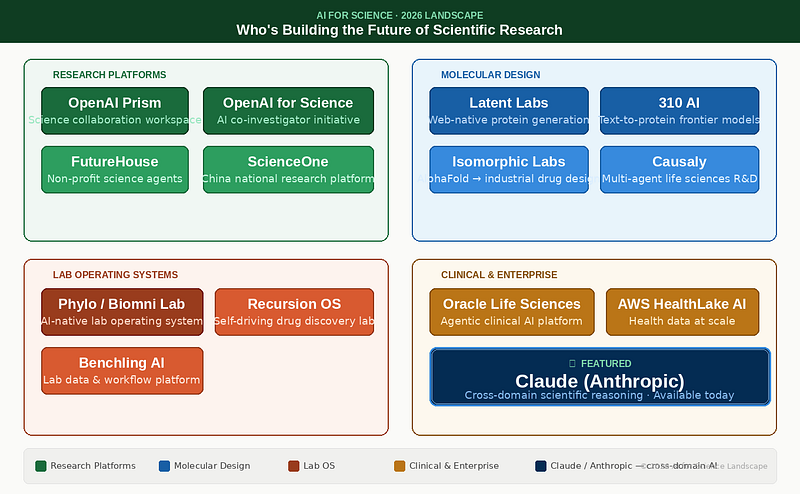
tl:dr We are living through the biggest transformation in scientific research since the internet. Here are the 11 AI tools already reshaping what it means to be a scientist — and a glimpse of where we’re heading next.
10 min read · AI, Life Sciences, Drug Discovery, Research
Click this Friend Link if you are stuck behind paywall
11Platforms profiled | $1.2B+ Raised in 2025–26 | 2026 is The breakout year
Let me ask you something: when did you last spend three hours reading contradictory papers before designing an experiment that returned ambiguous results — and then repeat the entire process?
If that sounds familiar, you’re in the right place. Because 2026 is the year that changes.
There’s a phrase that appeared in every investor deck and press release of the past 18 months: “AI for Science.” For a long time it felt like branding — a coat of paint slapped on a generic chatbot, a bid to sound serious. But something shifted in 2025, and by early 2026 the shift looks permanent.
AI for Science is now its own product category. Not a use case. Not a demo. A category — with dedicated startups, serious enterprise platforms, and the biggest model labs in the world explicitly building for researchers. The tools below aren’t prototypes. They are running in real labs, real clinical organisations, and real research institutions right now.
We are not watching AI assist scientists. We are watching AI become a scientist.— A quiet consensus forming across every major research institution in 2026
Here’s who’s building the future, what they’ve shipped, and — most importantly — what comes next.
Chapter 01
"ChatGPT Just Moved Into the Lab” — The Rise of Research Platforms
The first wave of “AI for Science” was embarrassing. A chatbot. A literature search. A paraphrasing tool dressed in a lab coat. Scientists saw through it immediately. The second wave is different — and it’s here.
OpenAI Prism🔬 Research Platform
The clearest signal of the shift. Prism is a cloud workspace where researchers organise projects, read literature, draft papers, and collaborate — all within a single environment powered by GPT-5.2. First time a frontier model company shipped a product explicitly branded “for scientists,” not a clever reframe of a general-purpose tool. Think of it as ChatGPT growing up and finally getting a proper job in the lab.
OpenAI for Science🤝 Co-Investigator AI
Running alongside Prism, this broader initiative frames AI systems not as tools, but as genuine research collaborators. Hypothesis generation. Experimental planning. Cross-disciplinary synthesis. This is the flag-planting moment — the biggest model lab saying science is a first-class product vertical. Not a side demo. Not a marketing slide. A core bet.
FutureHouse🌍 Non-Profit Infrastructure
Backed by Eric Schmidt and building from the other direction. Rather than starting with a model and adding science on top, FutureHouse is constructing specialised AI agents for tasks that academia actually needs: deep literature synthesis, chemical design, proof checking. The public-benefit counterpoint to the unicorn-hungry startups — AI for Science as infrastructure, not as a product pitch.
ScienceOne🇨🇳 National Platform
Launched by the Chinese Academy of Sciences, ScienceOne is a single national platform unifying AI tools for literature review, experiment planning, and lab execution across mathematics, physics, and biology — simultaneously serving thousands of scientists. While the West bets on startups, China is building centralised science infrastructure. Both bets deserve attention.
🤔 Think about this
When you last got stuck on a research problem at 11pm, what did you wish you had access to? A smarter search engine? A collaborator who’d read everything? A system that could tell you “three papers from 2022 already tried this approach and here’s what failed”?
That tool now exists. Does your institution know that yet?
Chapter 02
Protein Design Is Now a Browser Tab — The Molecular Revolution
For most of scientific history, designing a protein meant a PhD, a supercomputer cluster, and three years of postdoc time. AlphaFold was the first rupture. What happened next was faster, quieter, and arguably more consequential.
The capabilities that once lived only inside DeepMind’s research infrastructure are now accessible through a browser, to any scientist with a credit card. The protein design problem is increasingly a UI problem.
From “AlphaFold as a scientific curiosity” to “programmable biology in your browser” took exactly four years. The next four will be wilder.
Latent Labs🧬 Protein Generation
Founded by a former AlphaFold engineer, backed by tens of millions in venture funding. Latent-X is a self-serve tool for designing and optimising custom proteins and biomolecules — from a browser, without a computational biology PhD. This is what democratisation actually looks like: not access to a paper, but access to the tool.
310 AI📝 Text-to-Protein
Training what it calls “text-to-protein” models — generalist systems that generate functional protein sequences from natural-language descriptions. Trained on roughly 3.2 billion datapoints across 70 biological tasks. The post-AlphaFold thesis in a single sentence: we’ve moved from predicting what proteins look like to programming what they do.
Isomorphic Labs💊 Industrial Drug Design
DeepMind’s drug-design spin-out, now with around $600 million in external funding. The AlphaFold moment has entered its manufacturing phase. Structure prediction is now just one input to a much broader pipeline spanning target identification, molecule generation, and candidate selection. This is what “AI for drug discovery” looks like at industrial scale — end-to-end, not point solution.
💬 Worth considering
If you could describe a protein in plain English and have a model generate viable candidates within minutes, how would that change the first three months of a typical drug discovery project at your organisation?
Drop your answer in the comments — I’m genuinely curious about real-world timelines.
Chapter 03
The Lab Has a New Operating System — And It’s Agentic
The most operationally exciting corner of AI for Science is also the least glamorous to explain: AI agents that handle the cognitive grunt work so scientists don’t have to. Reading contradictory literature. Integrating internal datasets. Planning the next experiment. Interfacing with the actual instruments.
This is the “lab operating system” bet — and it’s being placed by startups, open-source communities, and enterprise software giants simultaneously.
Causaly🔍 Agentic R&D
Launched in late 2025 with specialised agents that read literature, integrate internal data, trace evidence chains, and complete complex drug discovery workflows. The critical differentiator: agents explain their reasoning and cite traceable evidence, rather than hallucinating plausible-sounding citations. Think of it as “LangChain for biology” — but with the domain specificity that pharma scientists actually require.
Phylo / Biomni Lab🤖 AI-Native Lab OS
Launched in 2026 with $13.5 million in seed funding. Biomni Lab wraps AI agents around hundreds of biological tools and databases — and connects to real instruments and wet-lab workflows. The vision is a single stack that plans your experiments, analyses omics data, and talks to your actual bench equipment. The open-source Biomni framework underpinning it is a strong signal: this infrastructure layer is expected to become commodity fast.
The question is no longer whether AI can assist in the lab. The question is whether your lab will have a human bottleneck five years from now — or not.
Chapter 04
The Quiet Giant: Why Claude Is Becoming Every Scientist’s Default Collaborator
Anthropic hasn’t shipped a product called “Claude for Life Sciences” in the way OpenAI has with Prism. And yet, ask researchers what AI tool they actually use daily — not for a specific task, but for the messy, non-linear work of science — and Claude keeps appearing.
The reason is structural, not accidental.
Most science-focused AI tools optimise vertically: protein design, clinical summaries, literature search. Claude’s strength lies in cross-domain reasoning — moving fluidly between biology, chemistry, statistics, clinical medicine, and regulatory science within a single conversation. Scientists are finding that the most valuable moments aren’t the tasks that fit a tool’s designed workflow. They’re the awkward, in-between moments: interpreting an unexpected assay result in the context of three conflicting published papers; structuring a regulatory submission that must be scientifically accurate and plainly written; reasoning through what a failed experiment actually means for the next hypothesis.
Claude (Anthropic)🧠 Cross-Domain Reasoning
Trained to express genuine uncertainty rather than generate confident-sounding but incorrect claims — a property that matters enormously when the downstream use is a clinical decision or a regulatory submission. Extended context means it can hold an entire research paper, an experimental dataset, and a live conversation simultaneously. For teams without the budget for dedicated enterprise platforms, Claude increasingly functions as a general-purpose scientific collaborator: available, fast, and honest about what it doesn’t know.
There’s something important in the way Anthropic has built Claude that’s easy to overlook: the model is deliberately calibrated to be useful under uncertainty. In a world where scientific questions are rarely cleanly resolved, that’s not a minor feature. It’s a design philosophy that happens to be exactly right for research.
💡 Quick question for you
Are you already using Claude, GPT, or another general-purpose AI in your research workflow? What’s the task where it surprised you most?
Genuinely curious — the most interesting uses I’ve heard about were never the ones the companies intended. Share in the comments.
Chapter 05
Big Pharma’s Quiet AI Revolution — Where the Real Money Is
The least glamorous but commercially most significant part of “AI for Science” isn’t happening in startups. It’s happening inside large pharmaceutical companies, contract research organisations, and health systems — where AI is quietly eating clinical development, HEOR, safety monitoring, and market access. Unglamorous work. Enormous leverage.
Oracle Life Sciences AI Data Platform🏥 Clinical Enterprise
Announced in January 2026, unifying 129 million+ de-identified patient records with trial and commercial data, then applying agentic reasoning to R&D and clinical workflows. Agents can propose analyses, generate synthetic control arms, surface label-expansion opportunities, and draft evidence packages for regulators. This isn’t a research curiosity. It’s enterprise infrastructure designed to compress the timeline from molecule to approval.
The common thread across Oracle, AWS HealthLake AI, and the enterprise health platforms: the bottleneck in drug development is no longer just the science. It’s the data engineering and evidence synthesis that surround it. That’s exactly where AI has the clearest and most measurable productivity unlock.
The Big Picture
Looking ahead → 2027 and beyond
We Are at the 1995 Moment for Scientific Research
In 1995, the internet existed. Researchers were already using email. A few early adopters had websites. But almost nobody understood what was about to happen — that within a decade, the way science was communicated, replicated, and funded would be transformed entirely.
We are at that moment again. Except the transformation this time will take years, not decades. Here is what we can already see on the horizon:
Within 2 years: AI agents will run entire literature reviews autonomously, flagging contradictions and gaps with higher reliability than any graduate student. Every major pharma company will have an agentic layer in its R&D stack — not as a pilot, but as core infrastructure.
Within 5 years: The time from target identification to IND filing for a class of diseases will shrink from years to months in AI-augmented programmes. AI will co-author papers, with formal citation and contribution norms emerging for model participation. Nobel-worthy hypotheses will begin to emerge from AI systems — and the debate over credit will be loud.
Within 10 years: The concept of a “scientific bottleneck” — that the rate of discovery is limited by human reading, reasoning, and experimental throughput — will be a relic. The bottleneck will shift to something harder: the ability to ask the right questions in the first place. Biology won’t be slow because of synthesis or screening. It will be slow because humans still have to decide what’s worth knowing.
The researchers who will thrive aren’t those who resist these tools. They’re the ones who learn to ask better questions — because questions will be the last scarce resource.
Final Thought
Three Forces Making 2026 the Breakout Year
- Frontier biology models are now commodity. AlphaFold 3, ESM3, and their successors are available via API, open-source, or as foundation layers. Any startup can build on state-of-the-art structure prediction without training it themselves.
- Multi-agent frameworks are production-ready. The infrastructure for multiple specialised AI agents to collaborate on complex research tasks — decomposing questions, delegating sub-tasks, synthesising results — is reliable enough to deploy at scale.
- Enterprise data is finally connected. Large pharma and research institutions have spent years accumulating clinical, genomic, and real-world data. The AI systems that can reason over that data — not just retrieve it, but propose hypotheses and evaluate evidence — have just crossed the quality threshold where enterprises will pay.
The result is a landscape that looks less like “AI applied to science” and more like the beginning of a fundamentally new kind of scientific practice: one where the cognitive heavy-lifting of reading, synthesising, designing, and analysing is increasingly shared with systems that don’t get tired, don’t miss the 2019 paper that changes everything, and don’t mind being asked the same question six different ways until the answer makes sense.
The lab is getting an upgrade. The question is whether you’ll be driving it — or watching it happen to someone else’s research programme.
📣 I want to hear from you
Which of these tools are you most excited about — or most worried about? Are you a researcher who’s already integrated AI into your daily workflow, or still watching from the sidelines? And what’s the one scientific problem you wish AI could solve that nobody seems to be building for yet?
Every comment gets a response. Let’s make this a conversation, not just an article.
If this made you think differently about science and AI — clap for it and hit follow.
Each clap costs you nothing and tells the algorithm this conversation matters. If you found value here, support us and keep independent science writing alive on Medium.
Following means you’ll get the next deep-dive — on autonomous labs, AI-authored papers, and the coming regulatory reckoning — as soon as it’s published. No spam. Just science.
Comments ()